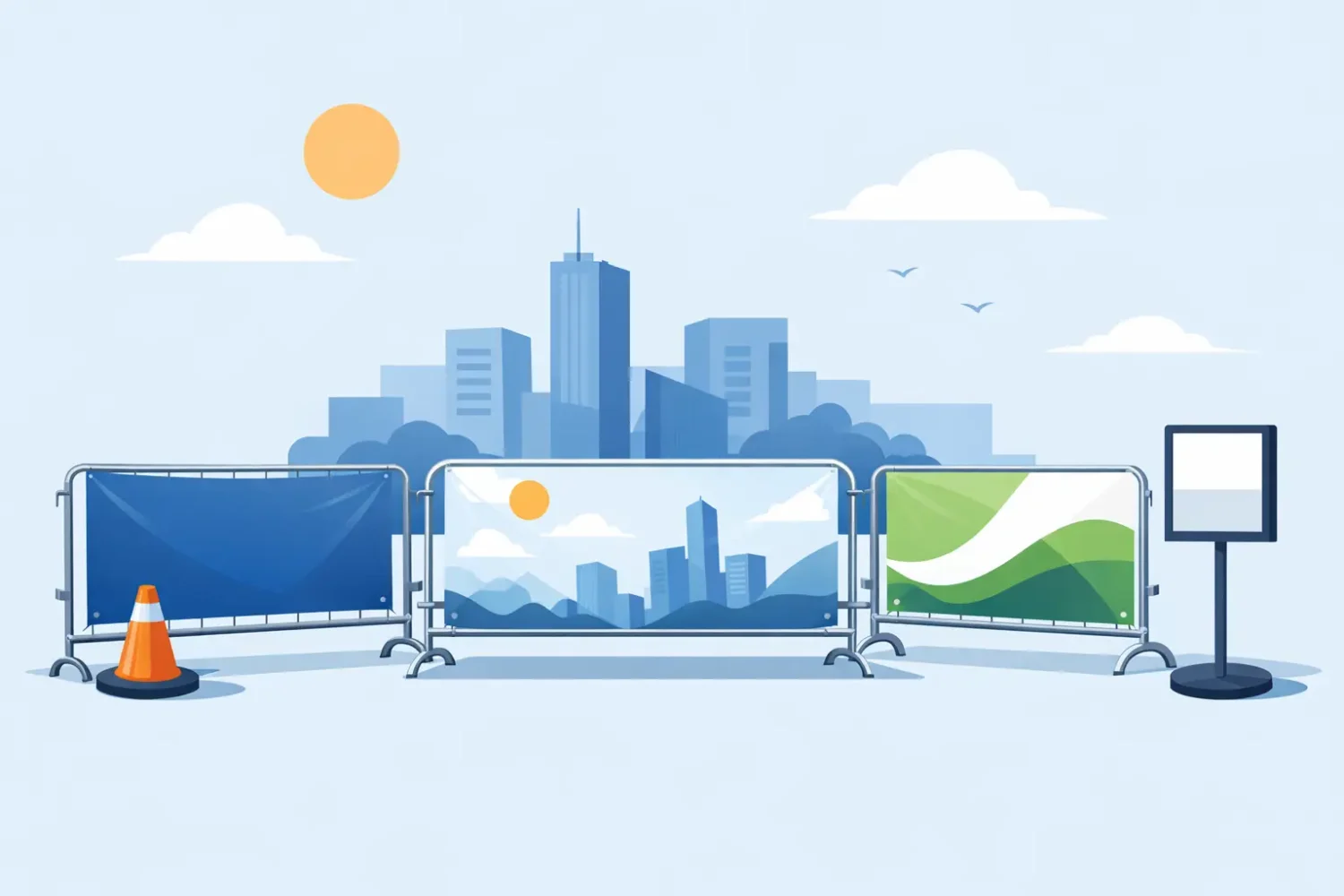
A plain metal barrier does crowd control. A barricade banner display system does crowd control and advertising at the same time. For event organizers, retail operators, and marketing teams, that difference matters because the barrier line is often one of the largest uninterrupted visual areas on site.
This format is simple in concept. A printed banner is fixed to a barricade frame or crowd control barrier so the hardware manages foot traffic while the graphic carries branding, promotions, directions, or sponsor visibility. It works because the barrier is already part of the environment. Instead of adding more stands, more floor hardware, or more sign clutter, the same footprint starts doing two jobs.
What a barricade banner display system is for
A barricade banner display system is usually used anywhere people need to be guided, queued, separated, or contained. That includes roadshows, mall activations, trade events, sports areas, construction perimeter branding, storefront launches, and temporary promotional zones. In practical terms, it converts a necessary operational item into a usable printed display.
For buyers, the value is not just visibility. It is efficient use of space. In a venue with limited floor area, freestanding displays can create congestion. Barricade graphics stay on the line of control that already exists, so they add messaging without adding another obstacle.
There is also a budget angle. If barriers are already required, attaching branded graphics can be more cost-effective than increasing the quantity of separate sign systems. That does not mean it replaces every display format. It means it fills a specific role well, especially when perimeter coverage matters more than height.
Where barricade banner display system setups work best
The strongest use case is a site where people naturally move along the barricade. Queue lines are the obvious example. A customer standing in line has repeated exposure to the printed surface, which gives promotional messages more viewing time than a quick walk-past poster.
Outdoor events are another common fit, but that is where material choice starts to matter more. Wind load, moisture, and sun exposure can change what print media and finishing method make sense. A banner intended for a covered mall concourse may not hold up the same way at an open-site event.
Retail launches and pop-up zones also benefit from this format because barricades can define a campaign area without making it look temporary or unfinished. A printed barrier line creates a cleaner edge around the promotion. It can also help direct traffic to entry points, sampling counters, or checkout zones.
In larger venues, barricade displays can do basic wayfinding if the artwork is handled properly. That said, this is not the best place for dense text. A barricade line is usually viewed at an angle or while moving. Short headlines, bold logos, directional arrows, and high-contrast graphics tend to perform better than detailed copy.
Hardware and print need to be matched correctly
This is where many buyers make the wrong assumption. They treat the hardware and the print as separate decisions. In practice, the success of a barricade banner display system depends on how well those two parts are matched.
The frame or barrier type affects banner size, attachment method, tension, and visible graphic area. Some systems are designed around dedicated display hardware, while others adapt to standard crowd control barriers. If the graphic is produced without checking exact hardware dimensions and mounting points, fit problems are common. Loose edges, blocked artwork, or poor tension can make even a high-resolution print look unfinished.
Print method matters too. A short-use indoor campaign may be fine with one material and finish, while a repeated-use outdoor setup may need a more durable print process and substrate. Solvent, eco-solvent, UV, latex, and dye sublimation all have different strengths depending on surface, color requirement, expected wear, and placement conditions.
That is why buyers often prefer sourcing both hardware and graphic production from the same supplier. It reduces the risk of receiving a banner sized for one system and hardware built for another. It also makes it easier to align finishing details such as hemming, eyelets, reinforcement, and mounting style.
Design considerations that affect results
A barricade graphic is not a brochure laid flat. It is a horizontal visual surface that people see in motion, from different distances, and often in a crowded setting. The design should reflect that.
Logos and campaign names should be scaled larger than many teams first expect. Fine print, small product details, and low-contrast brand colors can disappear quickly on a busy event floor. If the barricade is being used for sponsorship exposure, repeating the logo pattern across the panel often works better than placing one logo in the center and leaving the rest underused.
You also need to account for hardware interruption. Depending on the system, certain sections may be partially covered by poles, clamps, or frame edges. Important text should stay clear of those zones. This is a production issue as much as a design issue, and it should be checked before print approval.
If the display is part of a multi-format campaign, consistency helps. The barricade banner should align with nearby roll-up stands, counters, flags, popup backdrops, or light frames in color, typography, and message hierarchy. It does not need to carry every element from the main booth graphic, but it should clearly belong to the same campaign set.
Indoor vs outdoor use is not the same purchase
A lot of purchasing mistakes happen because buyers ask for a barricade display without defining the environment. Indoor and outdoor requirements can differ enough that they should be treated as separate applications.
For indoor use, cleaner print finish, color accuracy, and presentable tension are usually the main concerns. Shopping centers, exhibition halls, and product launches tend to prioritize appearance. The system should look neat at close range and photograph well.
For outdoor use, durability becomes more important. Exposure to wind, rain, handling, and transport can put more stress on both print and hardware. The right choice may involve stronger finishing, different media, or a revised artwork layout that tolerates movement better. Outdoor setups may also need a more realistic expectation of lifespan, especially for campaign graphics intended for repeated deployment.
Neither option is automatically better. It depends on whether the display is meant for a one-off activation, a seasonal promotion, or recurring event use.
What buyers should confirm before ordering
The fastest way to avoid rework is to confirm the operational details first. Barrier dimensions, quantity, usage environment, artwork size, viewing direction, and installation method should be clear before print starts. If one side faces the public and the other side faces staff or restricted space, that can affect whether single-sided or double-sided coverage is worth the cost.
It is also worth checking how often the system will be reused. A one-event campaign may justify a different material choice than a setup moving between Kuala Lumpur, Johor Bahru, and Penang for repeated activations. Reusability changes the math on hardware quality, print durability, and packing considerations.
Lead time matters as well. Barricade graphics are sometimes ordered late because buyers assume they are a minor accessory. They are not difficult to produce, but they still need proper sizing, print scheduling, finishing, and sometimes hardware coordination. If the event date is fixed, treating the barricade line as an early production item is the safer approach.
Why this format stays relevant
There are flashier display products. LED light frames attract more attention. Pop-up backdrops create a bigger branding wall. Beach flags add height and movement. But a barricade banner display system keeps its value because it solves a basic operational need while adding usable print area.
That makes it practical, especially for buyers managing real site conditions rather than ideal layouts. Not every venue has room for more display hardware. Not every campaign needs another standalone sign. Sometimes the better decision is to make existing infrastructure carry the brand message.
When the sizing is correct, the print method suits the environment, and the artwork is built for distance and movement, this format does its job cleanly. It controls the space, marks the perimeter, and keeps the branding visible where people are already looking. If you are planning barriers anyway, that is a straightforward place to get more value from the same footprint.
Related Posts