When a campaign needs shelf impact fast, holographic sticker printing wholesale usually comes up for one reason – standard labels do not catch light, motion, or attention the same way. For retail promos, product packaging, event giveaways, and branded merch, holographic stock gives a printed piece more visual lift without changing the core artwork.
That does not mean every holographic sticker order should be treated the same. Buyers who order at volume need to think beyond appearance. Material type, adhesive behavior, print method, finish, file setup, and application surface all affect whether the final batch works in-store, on-pack, or on-site.
What holographic sticker printing wholesale is really used for
In commercial printing, holographic stickers are not just novelty items. They are practical branding pieces used where visibility matters and unit cost needs to stay controlled across larger quantities. Marketing teams use them for promo handouts, product labels, limited-edition packaging, campaign seals, and event branding. Retail operators use them for price callouts, window messaging, and short-run promotional markings. Agencies often specify them when a client wants a premium effect without moving into more expensive packaging changes.
The wholesale part matters because volume buying changes the decision process. Once quantities increase, small production choices become budget issues. A laminate option, cut style, or adhesive upgrade that looks minor on a sample can shift the total order cost in a meaningful way.
Choosing the right holographic sticker printing wholesale spec
Most problems with sticker orders start before printing. The artwork may be fine, but the material or finishing choice does not match how the sticker will be used.
Material finish affects readability
Holographic stock reflects light, so artwork needs enough contrast to stay legible. Fine text, light tints, and low-contrast logos can disappear depending on viewing angle. If the sticker is meant for packaging or informational use, readability should come before visual effect. In many cases, bold solids and clean linework perform better than intricate gradients.
Some buyers want the holographic effect across the full sticker. Others only want it visible in uncovered areas of the design. That depends on how white ink, flood coverage, or selective printing is handled in production. If the visual goal is a controlled premium effect rather than a fully reflective label, this should be discussed early.
Adhesive and surface compatibility matter
A sticker intended for smooth packaging behaves differently from one applied to temporary event materials or takeaway items. Gloss packaging board, plastic containers, glass, PP surfaces, and coated cartons all react differently. If the sticker needs to stay fixed through handling, refrigeration, or transport, adhesive choice matters as much as the face stock.
For short-term promotions, a standard adhesive is often enough. For packaging that will be shipped, stacked, or exposed to varying temperatures, a more suitable specification may be needed. The right answer depends on the surface, storage, and how long the sticker is expected to remain in place.
Shape and finishing affect production efficiency
Custom die-cut holographic stickers look better in many branding uses, but they also require more setup than standard shapes. If speed and cost control matter more than custom contours, square, rectangle, circle, or kiss-cut sheet formats may be the better wholesale choice.
This is especially relevant for buyers placing repeat orders. A design that can be produced efficiently across multiple batches is often more useful than a one-time shape that complicates lead time and reordering.
Print methods and when they make sense
Holographic media can be paired with different production methods depending on quantity, artwork, and end use. There is no single best method for every job.
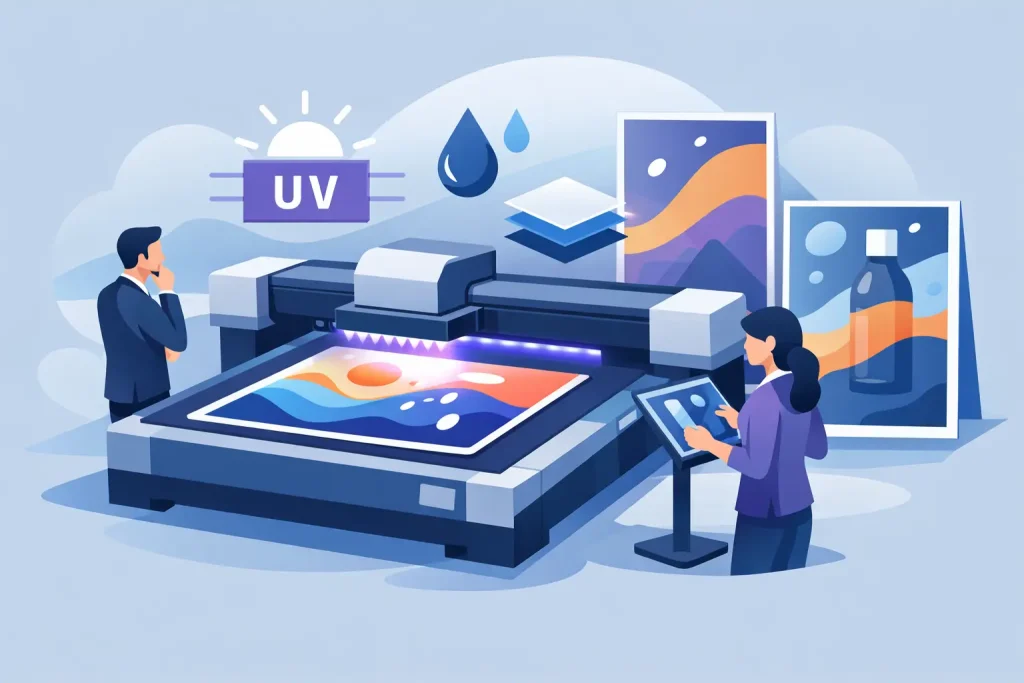
UV printing is a common fit when strong ink holdout and sharp color are required on specialty sticker materials. It is useful for bold graphics, branded labels, and commercial promo applications where consistency matters. Latex and eco-solvent options may also be appropriate for certain sticker runs, especially when matching existing print workflows or broader campaign output.
The practical point is this: buyers should choose based on application, not just machine name. If a campaign includes roll-up stands, boards, display panels, and sticker output in one order, production compatibility can save time. A supplier that handles multiple print categories and finishing methods can usually coordinate color intent and scheduling more effectively than splitting the work across separate vendors.
Artwork setup for better wholesale results
Wholesale sticker printing rewards clean files. Complicated artwork can be printed, but it tends to create more approval rounds, more waste, and more variation if the reflective stock changes how colors appear.
Use contrast intentionally
Dark inks generally read better on holographic stock. White layers can block the effect where needed, but this has to be planned in the file. If the goal is a metallic flash behind the logo, leave those areas exposed. If the goal is brand color accuracy, use proper coverage and do not assume the material will behave like white vinyl.
Build for cut tolerance
Tiny borders and edge-critical designs leave little room for normal production variation. For wholesale orders, especially higher quantities, designs should include proper bleed and safe zones. This is standard print practice, but it becomes more visible on reflective materials where edge alignment stands out more quickly.
Test before scaling quantity
Even experienced buyers benefit from a sample or pilot run when using holographic material for the first time. What looks strong on screen may be too reflective under retail lighting or too busy on small packaging. A short approval stage is cheaper than correcting a full-volume order.
Common commercial uses by buyer type
For retail, holographic stickers are often used on product packaging, promo labels, shelf markers, and limited-release items. The main goal is visual differentiation. A sticker can help a standard package feel like a special edition without changing the full print run.
For events and exhibitions, they work well as branded giveaways, badge elements, campaign seals, and promotional handouts. In this context, the reflective finish helps the brand stay noticeable in busy environments with competing visuals.
For agencies and procurement teams, holographic stickers often sit inside a wider asset list. A campaign may need labels, counter graphics, foam board visuals, lightbox prints, and portable display hardware at the same time. Consolidating those outputs with one commercial supplier simplifies production management and timing.
Cost trade-offs in wholesale buying
The cheapest unit price is not always the best buying decision. Sticker cost changes based on size, shape, print coverage, material grade, lamination, cutting method, and quantity break. A very low unit cost can be offset by slower application, poor adhesion, or lower shelf presence.
There is also a practical trade-off between standardization and customization. If the sticker will be used across many branches or repeated campaigns, a standard size and finishing spec usually makes procurement easier. If the job is tied to a one-off launch, more customization may be justified.
For businesses ordering across multiple locations, consistency matters. Buyers serving Kuala Lumpur, Johor Bahru, and other commercial centers often need repeatable output for chain retail, roadshows, or regional product launches. In that case, the best wholesale setup is the one that can be reordered without new production issues every time.
What to confirm before placing the order
Before approving a wholesale holographic sticker job, confirm the application surface, indoor or outdoor use, expected lifespan, quantity split, cut format, final size, and whether the design requires white backing or selective effect areas. Also confirm whether the stickers are supplied individually, on sheets, or on rolls, because handling requirements vary between packaging teams, event crews, and retail staff.
This is where a product-first supplier adds value. The job is easier when sticker material, print method, finishing, and related display output can be reviewed together instead of as disconnected items. My Inkjet fits that commercial model well because buyers can source specialty sticker materials alongside print production and display formats from one place.
Holographic stickers work best when the effect serves the job, not when the effect becomes the whole job. If the artwork is clear, the spec matches the surface, and the quantity is planned around real use, wholesale ordering becomes straightforward. The right batch should look sharp on delivery, apply cleanly in the field, and be easy to reorder when the next campaign is ready.
Related Posts