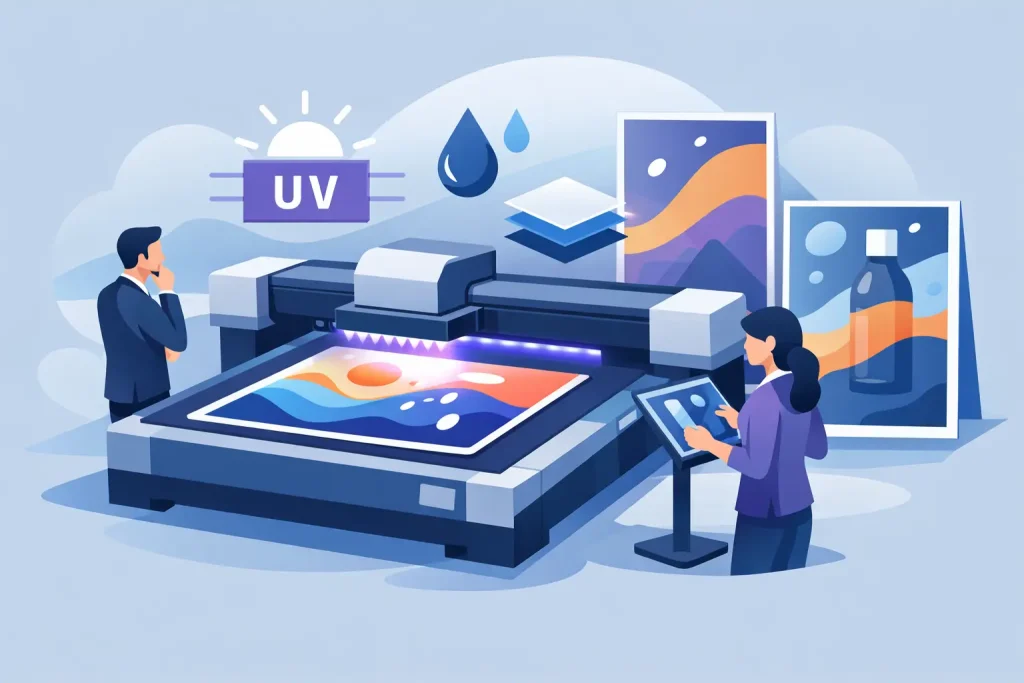
A display board can look right on screen and still fail on-site. Colors shift under retail lighting, text softens at viewing distance, or the surface scuffs before the campaign is halfway done. That is why uv printing for display boards is usually chosen for commercial graphics that need clean detail, consistent color, and a tougher finished surface across multiple display formats.
For business buyers, the question is not whether UV print looks good. The real question is where it fits better than solvent, latex, or other methods, and which board material will actually support the result you need. A promotion board for a supermarket aisle, a foam board for a product launch, and a mounted panel for a trade show wall do not all behave the same way, even if the artwork file is identical.
What uv printing for display boards does well
UV printing cures ink with ultraviolet light as it prints. In practical terms, that means the ink sets quickly on the surface instead of soaking deeply into the substrate. For display boards, this matters because it helps preserve edge sharpness, solid areas, and small text.
That makes UV a strong option for point-of-sale boards, promotional panels, mounted campaign graphics, event signage, and branded display pieces where a crisp finish is part of the job. Product photography tends to hold detail well. Bold brand colors usually reproduce with good density. On rigid media, the output often feels more production-ready straight off press.
Another advantage is material flexibility. UV can be used across a wide range of display-related surfaces, including foam board, PVC board, acrylic, KT board, and mounted graphic panels. If you are managing several formats in one campaign, that matters. It is easier to keep the look more consistent when one print method can support multiple display applications.
Where UV printing fits in a display board project
Not every board is doing the same work. Some pieces need to attract traffic from a distance. Others need to sit close to eye level with pricing, product details, or directional information. UV is especially useful when the board has to do both.
In retail, this often means shelf-side brand boards, freestanding promotional panels, countertop signs, and seasonal campaign displays. In events, it often applies to sponsor boards, registration panels, wayfinding signs, and mounted backdrops. In showrooms, it can be used for product feature boards and branded informational displays that need a cleaner, more premium presentation than temporary paper-based output.
The main reason buyers specify UV is control. When the campaign includes rigid displays, the print result is more predictable on the finished board. You are not just choosing an image. You are choosing how that image will sit on the material, how the surface will read under lighting, and how well it will hold up through handling and installation.
Choosing the right board matters as much as the print method
A common mistake is to treat the print process as the only decision that matters. In reality, board selection changes the result just as much.
Foam board is lightweight and widely used for short-term indoor promotions, presentation boards, and event graphics. It is easy to install and cost-efficient, but it is also easier to dent than denser rigid substrates. If the board is likely to be moved several times, packed for transport, or installed in a high-contact area, foam board may not be the best fit even if the print quality is excellent.
PVC board is a more durable option for many commercial uses. It suits retail signs, promotional boards, menu-style displays, and medium-term indoor campaigns. It has a more solid feel, handles mounting well, and generally performs better when durability matters.
KT board is often selected for lightweight promotional use where budget and speed are priorities. It works for short-run campaigns, in-store visuals, and temporary event signage, though it is not the strongest option for repeated handling.
Acrylic can produce a more polished, higher-end presentation for branded interiors, product showcases, and illuminated or premium display applications. The trade-off is cost and, in some cases, installation complexity.
If the board will be mounted into a frame, fixed to a stand, or inserted into a display system, thickness and rigidity also matter. Good print output can still become a bad finished job if the substrate does not suit the hardware.
Image quality, finish, and viewing conditions
UV printing is often chosen because it produces sharp graphics, but sharpness alone is not enough. The board has to work in the actual environment where people will see it.
A board viewed from six feet in a store aisle needs impact first. A board viewed from one foot away at a registration counter needs cleaner fine detail. If the artwork includes small text, QR codes, pricing tables, or technical content, the file setup and board surface need to support that use case.
Finish also changes perception. Some jobs need a gloss effect for stronger color pop. Others need a more controlled surface to reduce glare under spotlights or retail fixtures. This is where application matters more than preference. A glossy board can look strong in one setting and become harder to read in another.
Color expectation should be handled practically. UV can produce vivid output, but brand matching depends on artwork quality, substrate choice, and production setup. A logo printed on white PVC will not always look identical to the same file mounted on a different board with a different surface character. Buyers managing multi-piece campaigns should think in terms of overall consistency, not just isolated sample appearance.
Durability is a benefit, but it has limits
UV output is generally a solid choice when display boards need better resistance to handling than basic temporary graphics. That is one reason it is frequently used for commercial displays that move from production to packing to installation on a tight schedule.
Still, durability depends on the full construction, not only the ink. A UV-printed graphic on a weak or easily dented board will still be vulnerable at the corners and edges. If the board is for a roadshow, mall activation, or exhibition setup that gets reused across locations, construction planning matters just as much as print resolution.
Indoor versus outdoor use also changes the decision. Many display boards are intended for indoor campaigns, where UV performs well in terms of appearance and practical wear. For outdoor exposure, it depends on the duration, substrate, mounting method, and weather conditions. A short-run outdoor promotional board is different from a long-term exposed sign panel. Buyers should specify the environment early so the board and print method can be matched correctly.
Production speed and campaign efficiency
One of the more practical reasons companies choose UV printing for display boards is turnaround. Commercial campaigns often involve multiple items at once – boards, stands, counters, backdrops, stickers, and other branded materials. When the print method supports direct output on rigid or display-ready surfaces, production can move faster with fewer process changes.
That matters for retail launches, exhibitions, and short booking windows where marketing teams are coordinating approvals, delivery schedules, and installation timing at the same time. A supplier that can handle both display hardware and printed graphics reduces coordination issues. Instead of splitting the stand from one vendor and the board from another, the project can be aligned around actual fit, sizing, and usage.
This is especially useful for buyers managing campaigns across multiple cities such as Kuala Lumpur, Johor Bahru, or Penang, where consistency matters as much as speed. When the same board format is repeated across locations, production control becomes a purchasing advantage, not just a technical one.
When UV is the right call and when it is not
UV is a strong choice when you need sharp graphics on rigid display materials, decent durability, fast production, and compatibility across several board types. It is often the right fit for promotional boards, in-store signage, event displays, and mounted campaign visuals where presentation quality needs to stay reliable through handling and installation.
It may not always be the first choice if the job is purely flexible media, highly cost-driven, or built around a substrate better suited to another print process. It also may not be necessary for every short-term indoor sign if a simpler production route can meet the purpose. The board, the environment, and the campaign duration should drive the decision.
If you are ordering display boards for a real commercial use, the best approach is straightforward: start with the format, confirm the viewing conditions, then match the substrate and print method to the job. Good display output is not about picking the most advanced option on paper. It is about choosing the method that keeps the board looking right once it is installed and doing its work.
Related Posts