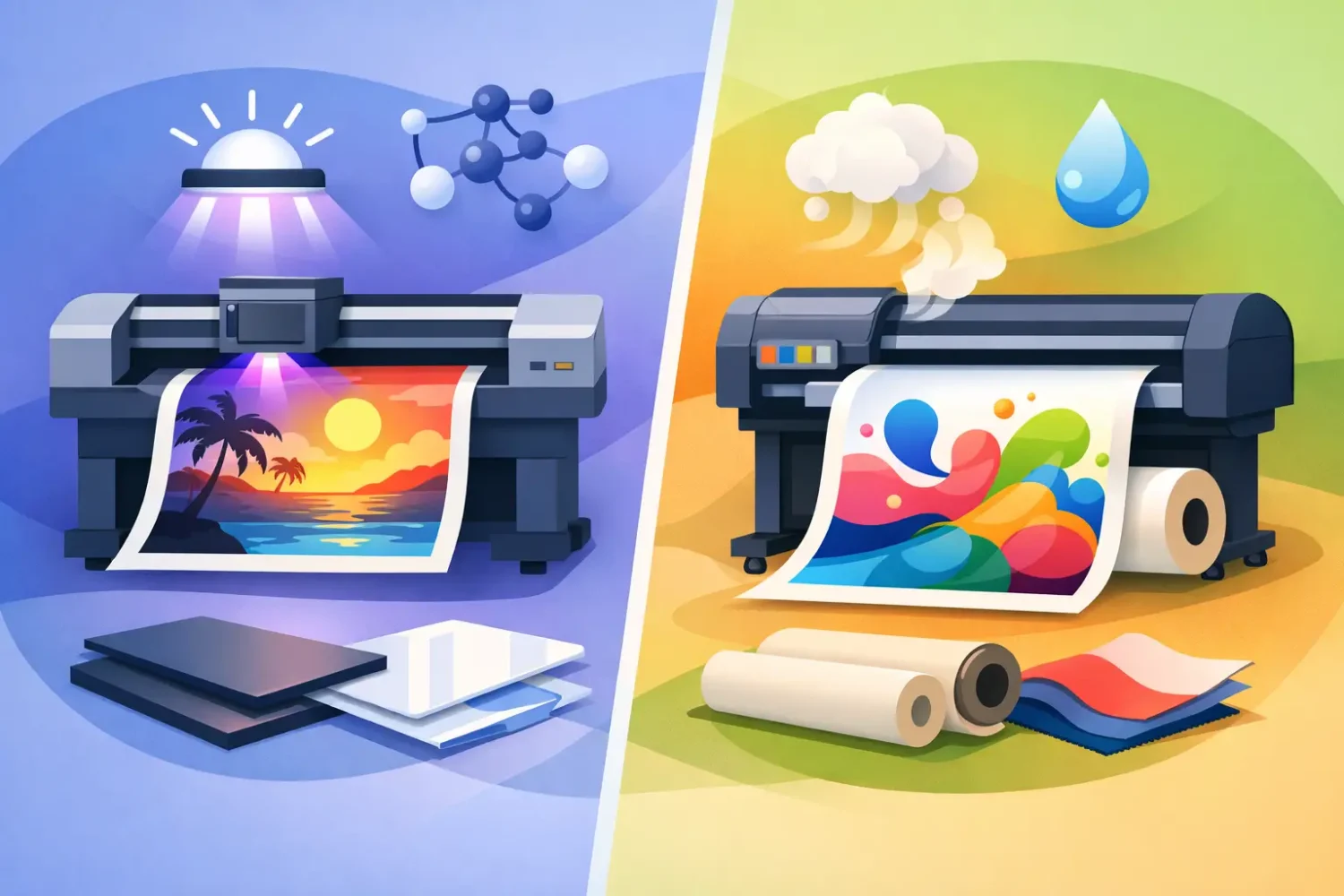
When a job calls for large-format graphics, the print method affects more than image quality. In the uv printing vs latex printing decision, the real question is how the finished piece will be used – indoors or outdoors, mounted to rigid board or applied as flexible graphics, viewed under retail lighting or exposed to weather, transport, and repeated handling.
For business buyers, this is usually not a technical debate for its own sake. It is a production choice tied to substrate, turnaround, installation method, and lifespan. A pop-up backdrop, a window graphic, a roll-up banner, a barricade display, and a mounted promotional board can all look sharp, but they do not all benefit from the same print process.
UV printing vs latex printing: the core difference
UV printing uses ultraviolet light to cure the ink almost instantly on the surface of the material. The ink sits more on top of the substrate rather than soaking deeply into it. This makes UV suitable for a wide range of rigid and flexible materials, especially when strong surface color and direct printing capability are needed.
Latex printing uses water-based inks with latex polymers that are heat-cured during production. The result is a print that is often more flexible and well suited to roll media used for signage, wall graphics, posters, and self-adhesive applications. It is commonly chosen for jobs where the media needs to bend, wrap, or roll without the ink layer becoming a concern.
That basic difference matters because print performance is tied to the physical behavior of the substrate. If the job is going onto foam board, acrylic, PVC board, KT board, or another rigid sheet, UV often makes immediate sense. If the job is a sticker, poster film, banner roll, or display graphic that will be transported in a tube or cassette, latex often has practical advantages.
Where UV printing makes more sense
UV printing is usually the stronger option when you need direct printing onto rigid materials. For retail signs, indoor promotional boards, exhibition panels, menu boards, and branded display surfaces, this reduces extra production steps. Instead of printing to one media and mounting it to another, UV can often print directly to the final board.
That saves time on some jobs and can improve alignment on double-sided or cut-to-size work. It also supports a broad material range, which is useful when a campaign includes multiple display formats. A procurement team ordering counters, standees, mounted boards, and event signage may prefer one method that handles several board-based outputs cleanly.
UV also tends to produce sharp detail and strong color on smooth surfaces. If the graphic includes small type, dense brand colors, or high-contrast product visuals, UV can deliver a crisp result. For point-of-sale material and short-viewing-distance applications, that surface sharpness can be valuable.
The trade-off is flexibility. Because UV ink forms a cured layer on the surface, it may be less forgiving on media that will be stretched, folded, or handled aggressively. On some applications, especially where the print must conform around curves or stay highly flexible over time, latex may be the safer production route.
Where latex printing makes more sense
Latex printing is often the better fit for flexible media and graphics that need to move through finishing, packing, transport, and installation with minimal issues. Roll-up banners, posters, wall coverings, vinyl graphics, and many self-adhesive materials are common examples.
Because latex prints are generally more flexible, they work well when the material needs to be rolled and unrolled repeatedly. That matters in event and exhibition use. A graphic for a retractable stand or portable display system is not just about how it looks on day one. It also has to travel, install quickly, and still present well after repeated use.
Latex is also a practical option when the application includes close-contact indoor environments such as retail interiors, office branding, and public-facing display spaces. Buyers often choose it for wall graphics and indoor promotional visuals where finish consistency and media compatibility are key.
That does not mean latex is always the better indoor choice and UV is always the better outdoor choice. Both can be used across indoor and outdoor applications depending on media, lamination, and exposure conditions. The difference is more about how the print sits on the material and how the finished graphic needs to behave.
Print quality, finish, and surface behavior
On paper, both methods can produce commercial-grade output suitable for branding and marketing use. In practice, the visual difference shows up in the finish and the feel of the print on the substrate.
UV can appear slightly more surface-forward because the cured ink remains on top of the material. On rigid boards or specialty substrates, that can create a bold, defined look. It is often a good match for mounted promotional graphics, display boards, and printed panels that need visual impact at retail or exhibition distance.
Latex typically integrates well with flexible coated media and adhesive stocks. The finish can look smoother on applications designed for roll media, especially when the end use involves lamination, contour cutting, or mounting after print. For branded stickers, wall applications, and transportable display graphics, that smoother media behavior can matter more than raw surface punch.
If the job includes unusual substrates such as transparent film, hologram sticker material, matt silver finishes, or synthetic stocks, production suitability depends on the exact media specification, not just the print method category. That is where a supplier with multiple print options is useful. The right question is not which technology is better in general. It is which technology is right for the material you are actually ordering.
Durability and handling in commercial use
Durability should be judged by real usage conditions, not only by whether a print is called indoor or outdoor. A storefront promotion facing sun and rain has different demands from a conference backdrop used three times a year. A counter graphic handled by staff every day behaves differently from a ceiling-hung sign installed once.
UV printing is often selected for rigid signs and mounted displays because it holds up well on hard surfaces and supports direct-to-board output. For fixed-format signage, promotional boards, and display panels, that is efficient and practical.
Latex printing is often preferred where the graphic will be flexed, rolled, laminated, or installed onto surfaces that require the print to remain pliable. This is one reason it is common in wall graphics, vinyl-based applications, and portable event display graphics.
If abrasion, repeated transport, or edge lifting is likely, finishing choices matter as much as print method. Lamination, proper mounting, and suitable media specification can extend performance significantly. Buyers sometimes compare UV and latex as if print technology alone decides everything, but production setup is what determines whether the graphic survives real use.
Cost, turnaround, and job suitability
There is no universal rule that one is always cheaper. Cost depends on quantity, material, finishing, job size, and whether the print is direct-to-substrate or printed to media and mounted afterward.
UV can be cost-effective on rigid applications because it may remove an extra mounting step. For board signage, standees, mounted promotional panels, and certain display components, that production path is straightforward.
Latex can be efficient for roll-fed jobs, especially when the order includes multiple banner graphics, posters, stickers, or display visuals for systems like roll-up stands and backdrops. For campaign work that combines several flexible formats, it can be a practical production choice.
Turnaround also depends on workflow. If a supplier handles both display hardware and graphic output, the print method can be matched to the final product instead of treated as a separate procurement issue. That is often more useful to a buyer than chasing a theoretical best method on its own.
How to choose between UV and latex for your project
If the job is board-based, rigid, and intended as a finished panel or sign, UV is usually the first option to check. If the job is flexible, rollable, adhesive, or part of a portable display system, latex is often the better starting point.
Still, there are edge cases. Some flexible materials print well with UV depending on the application. Some indoor rigid graphics may be produced through other workflows if the finish requires it. The safest route is to define the display format first, then the substrate, then the environment, then the finishing requirements.
For example, a retail operator ordering window stickers, wall branding, and sale posters is likely solving a latex-led brief. An event organizer producing branded boards, counters, directional signs, and mounted sponsor panels is more likely looking at UV for part of the package. A mixed campaign may need both.
At that point, the value is not in forcing one process across every item. It is in using the print method that fits each format with the fewest production compromises.
If you are comparing UV and latex for a live campaign, start with the actual product list, not the machine type. That usually leads to the right answer faster.
Related Posts