A foam board sign that needs sharp color by tomorrow, a window graphic that cannot smudge during installation, a display panel printed directly onto a rigid sheet – these are the kinds of jobs that raise the question of when to use UV printing. For business buyers, the answer usually comes down to substrate, durability, turnaround, and where the finished graphic will be used.
When to use UV printing
UV printing is the right choice when you need direct printing on rigid materials, strong surface durability, and consistent graphic output across signage and display applications. It is commonly used for foam board, acrylic, PVC board, KT board, corrugated plastic, wood, and other substrates that are difficult or inefficient to run through other print methods.
This matters in commercial environments because not every campaign uses flexible media alone. Retail promotions, exhibition walls, counter wraps, menu boards, standees, directional signs, branded panels, and point-of-sale displays often require a print process that can handle board materials without extra mounting steps. If your artwork needs to go straight onto the final surface, UV is often the practical option.
Why UV printing fits commercial display work
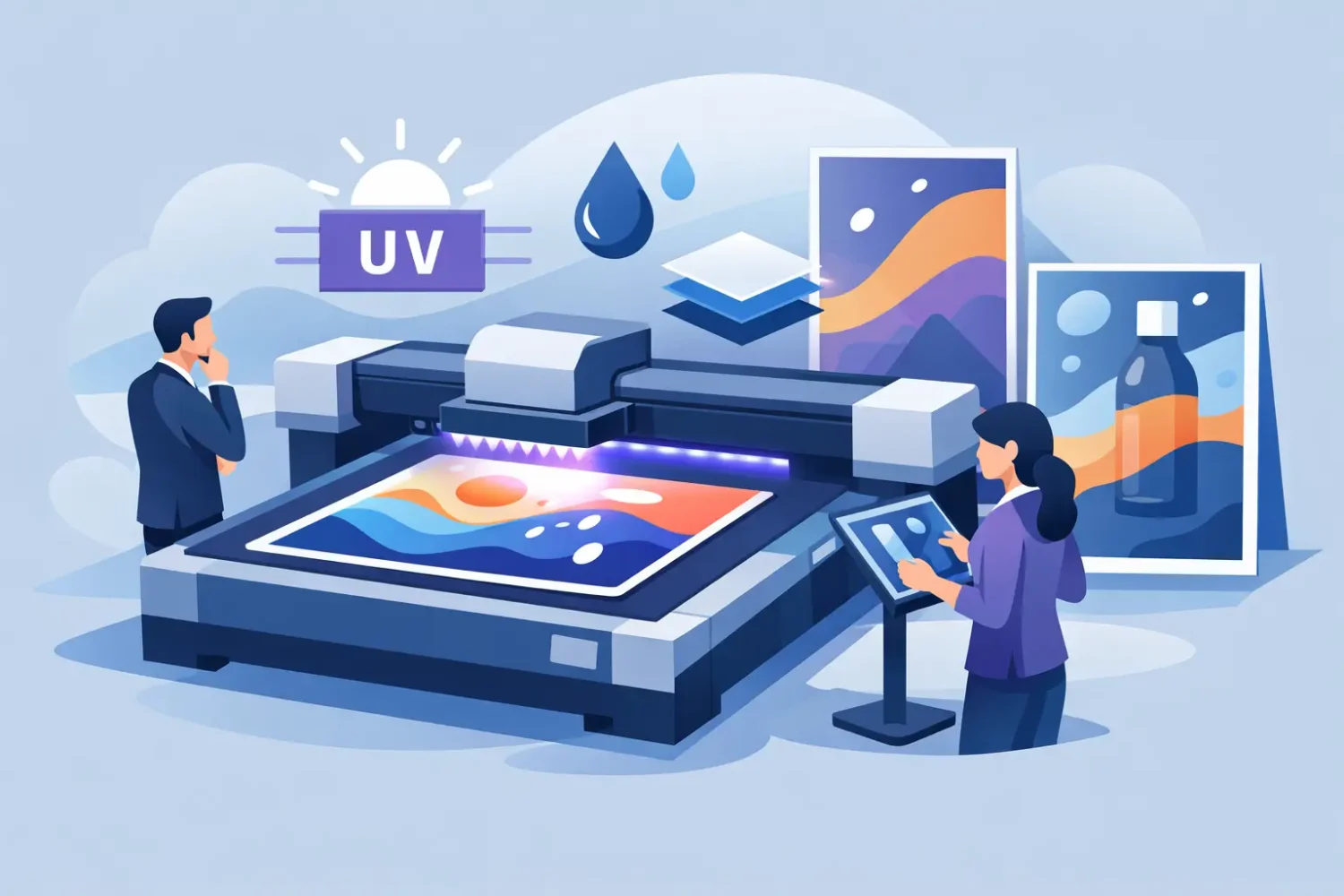
UV printing uses ultraviolet light to cure the ink almost immediately on the material surface. In practical terms, that means the print is dry as it comes off the machine. For production buyers, this reduces handling delays and helps move jobs faster into cutting, packing, or installation.
The other reason UV is widely specified is material range. Large-format campaigns rarely stay within one format. A launch may include a roll-up stand, a promotional counter, hanging signs, shelf talkers, window decals, and mounted boards. UV printing is useful when part of that package includes rigid display components that need sharp imaging and a finished look without lamination in every case.
For a supplier with both print production and display hardware, this is where UV becomes operationally efficient. The same order can include the structure and the printed panel, instead of splitting rigid graphic production across another vendor.
Best use cases for UV printing
Rigid signage and mounted boards
If the job calls for KT board, PVC board, acrylic, wood panel, or similar sheet material, UV is often the first method to consider. It prints directly to the board, which saves time compared with printing onto vinyl and mounting afterward. That can simplify production for indoor signs, promotional boards, branded backdrops, and presentation panels.
This is especially useful for short-term retail and event graphics where clean appearance matters, but the job does not need the extra production step of separate mounting unless the application specifically calls for it.
Point-of-sale and retail display graphics
Retail graphics often need to look crisp at close range. Price communication, product callouts, countertop signs, aisle displays, and branded panels are typically viewed from a short distance, so image sharpness and text readability matter. UV printing performs well here, particularly on rigid media used in stores, showrooms, and pop-up retail setups.
It also helps when multiple display elements need to match. A campaign might include a counter graphic, shelf signage, freestanding boards, and a header panel. UV keeps those rigid elements within one print workflow.
Exhibition and event panels
Trade shows and roadshows often combine structure with interchangeable graphics. UV printing is a good fit for branded panels, stage boards, product information displays, registration counters, and stand components that need to look solid under venue lighting.
For event buyers, one practical advantage is speed. If a rigid panel must be printed, finished, and packed on a tight schedule, UV can support that workflow better than processes that require longer drying time or added mounting stages.
Outdoor signs with moderate durability needs
UV printing can be used for selected outdoor applications, particularly where the substrate itself is suitable for exterior use. Temporary outdoor promotions, wayfinding boards, site signs, and campaign signage can work well with UV output.
That said, outdoor lifespan depends on more than the print method. Sun exposure, rain, heat, handling, and the material choice all affect performance. A short campaign board outside a storefront is different from a long-term sign installed in full weather exposure. In those cases, the better question is not just when to use UV printing, but whether the total construction is appropriate for the duration.
When UV printing makes more sense than other methods
A buyer comparing UV with solvent, eco-solvent, latex, or dye sublimation should not think in terms of one method being universally better. Each has a job.
UV usually makes more sense when the final piece is rigid, when direct-to-substrate production saves time, or when you need a broad range of material compatibility. If the artwork is going on a board, panel, or specialty sheet, UV is often more straightforward than printing to adhesive media and mounting later.
By contrast, solvent and eco-solvent are often better aligned with roll media, stickers, banners, and flexible sign applications. Dye sublimation is typically the stronger fit for fabric graphics and soft signage. Latex can be a good choice for certain indoor graphics and wallcovering work. The practical decision is based on the finished format, not just the printer.
Where UV printing may not be the best option
Fabric displays and textile graphics
If the graphic is for a fabric backdrop, tension fabric stand, or textile lightbox face, UV is usually not the preferred method. Dye sublimation is often better for soft signage because it integrates well with fabric materials and supports the look and handling those systems require.
Flexible graphics that need stretching or folding
Some flexible media applications perform better with print methods designed for roll-fed materials. If the graphic will be folded repeatedly, tensioned, or wrapped around curves, the substrate and ink behavior matter. UV can work on flexible media in some cases, but it is not automatically the best fit for every flexible application.
Jobs where surface texture is a concern
UV ink sits on the surface and cures there. On some materials, that is exactly what you want. On others, especially if you are after a very specific finish or tactile effect, the surface feel may be a factor. For premium close-contact applications, it is worth checking whether the print appearance matches the intended use.
Material choice matters as much as print method
A common buying mistake is choosing the print method first and the substrate second. In commercial display work, the material often decides the process.
For example, acrylic signage may favor UV because direct printing creates a clean, modern result. KT board and PVC board displays also fit naturally with UV for promotional use. Corrugated plastic signs can be a practical choice for temporary campaigns. Wood and specialty boards may also be suitable when the project needs a more custom presentation.
The smarter route is to define the application first: indoor or outdoor, temporary or ongoing, rigid or flexible, close-view or distance-view, mounted or free-standing. Once those requirements are clear, the print method usually follows.
What business buyers should ask before specifying UV
Before approving production, ask what the graphic will be mounted on, how long it needs to last, whether it will be handled frequently, and if color consistency across multiple display formats matters. Also ask whether direct printing will reduce finishing time compared with mounting a separate print.
If the project includes several items – such as roll-up stands, counters, foam boards, and stickers – it is normal for one campaign to use more than one print method. That is not a problem. It is usually the most efficient way to match output to each format.
For companies ordering event and retail graphics at scale, this is where a supplier with multiple production capabilities becomes useful. Instead of forcing every application into one process, the job can be split according to material and use case.
A practical way to decide
Use UV printing when the graphic needs to go directly onto a rigid surface, when fast production matters, and when the finished piece is part of a signage or display system rather than a soft graphic. It is a strong fit for promotional boards, retail signage, event panels, branded counters, acrylic pieces, and many point-of-sale materials.
If the job is fabric-based, highly flexible, or built around roll media, another print process may be the better choice. The most reliable decision is not based on trend or preference. It is based on the display format, the substrate, and how the graphic will actually be used once it leaves production.
The easiest jobs to approve are the ones matched correctly from the start. If the material is doing half the work, UV printing often does the rest.
Related Posts