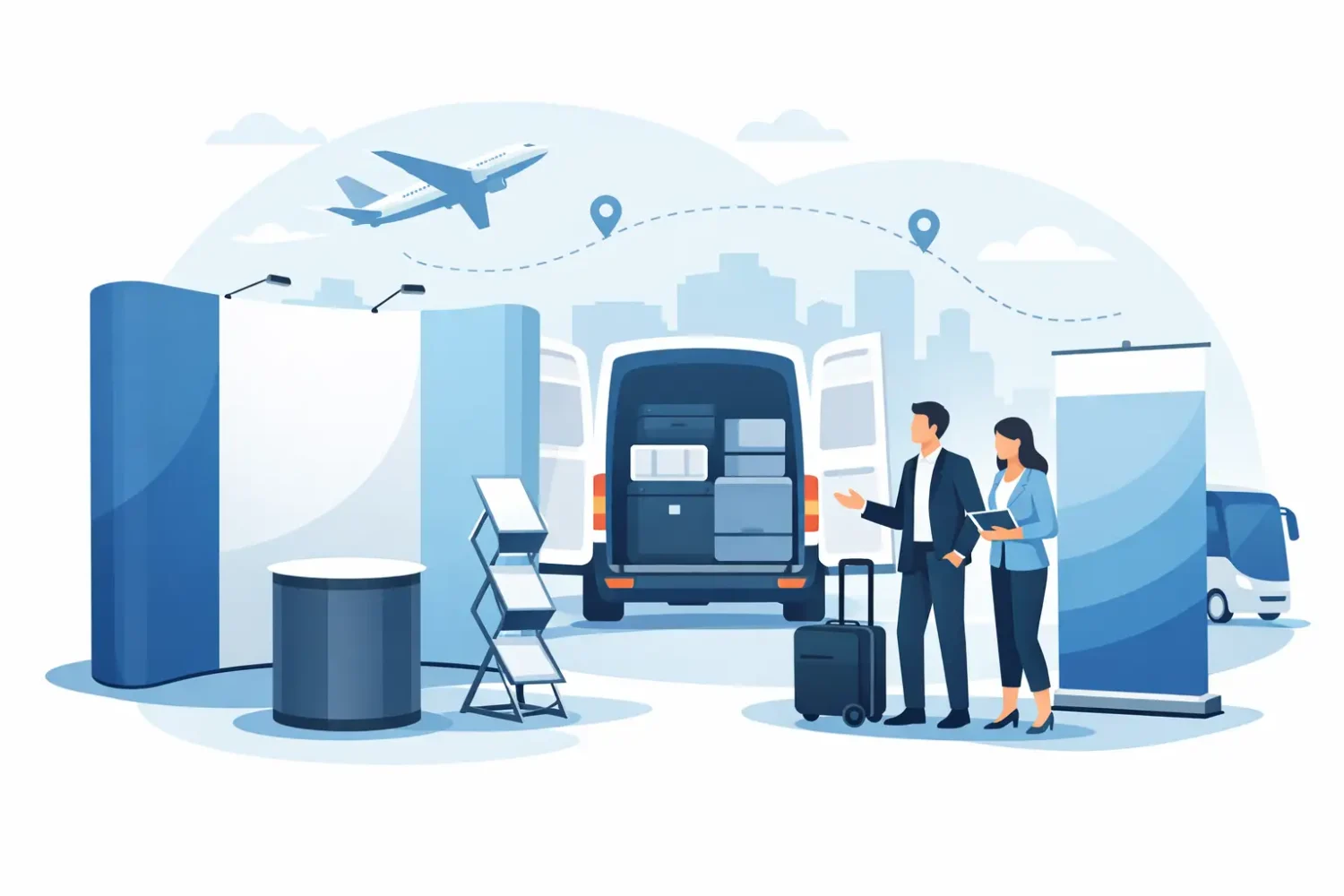
A roadshow display is handled more often than a typical retail sign. It is packed into a vehicle, carried through loading areas, set up under time pressure, and viewed at close range by people moving past a booth. The best displays for roadshows are not simply the largest or most eye-catching formats. They are the formats that suit the venue, crew size, campaign message, and number of stops on the schedule.
For most campaigns, the practical requirement is a display system that combines portable hardware with replaceable, professionally printed graphics. That gives marketing teams the freedom to reuse their structures while updating offers, product imagery, or event messaging between campaigns.
Best Displays for Roadshows by Campaign Need
There is no single display type that works for every roadshow. A mall activation, dealer event, campus campaign, and corporate product launch each have different space restrictions and visitor behavior. Start with what the display must do: attract from a distance, provide information, create a branded backdrop, support a product demonstration, or direct visitors to a counter.
Roll-up stands for fast setup
Roll-up stands are one of the most practical roadshow formats because the printed banner stores inside its base. The operator opens the support pole, pulls up the graphic, and secures it in place. This makes the format suitable for campaigns moving between several locations in one week.
PVC roll-up stands are a standard choice for indoor promotions, registration areas, retail corridors, and booth entrances. They work well for a single message such as a promotion, price point, product benefit, QR code, or event schedule. A pair of roll-up stands can frame a counter, while several units can create a simple branded area without requiring a full exhibition structure.
The trade-off is visual scale. A roll-up stand is efficient, but it does not provide the same high-impact background as a popup display or LED light frame. Use it where speed, quantity, and compact packing matter more than a large scenic presentation.
Popup displays for a complete event backdrop
Popup displays are built for roadshows that need an immediate branded wall behind staff, products, or a demonstration area. The frame expands into position and supports a larger graphic surface than individual banner stands. This makes a popup system useful when the campaign needs a clear focal point for photography and visitor engagement.
A popup display is a better fit than multiple roll-up stands when the team needs one uninterrupted visual message. Product launches, financial service promotions, property campaigns, and corporate roadshows often benefit from this format because logos, large images, and campaign headlines remain visible across a wider area.
However, larger systems require more storage space and more careful handling. Confirm the case size, vehicle capacity, and whether one person can manage setup comfortably. For a high-frequency route with small teams, a medium-sized popup may be more practical than the largest available frame.
LED light frames for high-visibility locations
LED light frames are designed for graphics that need to stand out in bright retail environments, hotel function spaces, convention halls, and evening activations. Internal illumination gives backlit graphics stronger color presence and can make product imagery, beauty visuals, food photography, and premium brand campaigns more noticeable.
This format is especially useful when the roadshow shares a venue with competing signage. A standard printed backdrop can disappear under uneven venue lighting, while a backlit display maintains visibility. LED light frames also give a more finished appearance for brands that need a polished presentation rather than a temporary booth look.
The operational consideration is power. The event team must check outlet access, cable routing, and venue rules before selecting illuminated hardware. LED systems also need more protection during transportation than a basic roll-up stand. For a one-day kiosk with no nearby power source, a printed popup or fabric display may be the better decision.
Counters for leads, samples, and transactions
A roadshow setup often fails when there is no working surface. Promotional counters provide a place for brochures, product samples, lead forms, tablets, payment devices, or staff conversations. They also create another printable branding area at eye level.
Counters are useful even when the main display is small. A roll-up stand behind a branded counter can form a compact activation station for sampling, registration, and retail promotions. For campaigns with product demonstrations, select a counter with enough top surface and load capacity for the equipment being used.
Do not treat the counter graphic as an afterthought. Visitors standing in front of it will see that panel at close range. Use a clear logo, short message, and simple color block rather than a crowded version of the main backdrop design.
Beach flags and directional displays
Beach flags are effective for directing visitors toward a roadshow location, especially in open atriums, outdoor plazas, sports venues, and entrance areas. Their tall vertical shape makes them visible above pedestrian traffic, while their movement helps draw attention in outdoor conditions.
For indoor use, confirm that the venue allows flags and that the base suits the floor type. For outdoor use, choose the correct base or water weight for wind conditions. A beach flag should support the main display system, not replace it. Its job is to create visibility and guide foot traffic toward the activation area.
Match Hardware to the Roadshow Route
The right display is determined as much by logistics as by design. Before ordering, review the route as an operations plan. Count the number of venues, installation hours, staff members, vehicle type, and times the graphics will be changed.
A campaign with ten quick mall stops needs lightweight hardware, compact cases, and graphics that can be installed by a small team. A longer corporate tour with scheduled setup crews can justify larger popup walls, LED light frames, and multiple counters. If the display must travel by courier between cities, hard cases and simple assembly become more valuable than extra accessories.
It is also worth planning for replacement parts. Support poles, bases, graphic panels, connectors, and carry bags can be damaged over repeated use. Choosing standard display formats makes it easier to maintain a consistent setup across multiple events instead of redesigning the entire booth after one hardware issue.
Choose Print Materials for Viewing Distance and Reuse
Display hardware gets attention, but the printed graphic determines how the campaign is perceived. Roadshow graphics need readable type, accurate brand color, and materials appropriate to the display format.
For roll-up stands and popup systems, the print should remain flat, resist visible curl, and hold up through repeated installation. Solvent, eco-solvent, UV, latex, and dye sublimation printing each suit different substrates, finishing requirements, and visual outcomes. The appropriate method depends on the material, expected durability, color requirement, and whether the graphic is used indoors or outdoors.
UV printing is useful for rigid display elements and selected board applications where crisp detail is required. Latex and eco-solvent production can suit a range of flexible graphic materials. Dye sublimation is often selected for fabric graphics because the color is integrated into the textile, creating a softer finish that is practical for some portable frame systems.
Avoid placing essential copy at the bottom edge of a banner or behind a counter. Keep the main headline high enough to be seen over visitors, and make the call to action readable from the expected viewing distance. A roadshow is not a brochure. If the message needs more than a few seconds to understand, reduce the copy.
Build a Display Set, Not a Single Item
The strongest roadshow setups use display formats with separate jobs. A large backdrop establishes the campaign. A counter gives staff a working point. Roll-up stands explain supporting offers. Directional flags or signs pull visitors toward the space.
For a compact setup, use one roll-up stand and one branded counter. For a standard mall activation, combine a popup display, counter, and two roll-up stands. For a higher-visibility launch, add LED light frames and directional displays where the venue permits them. The point is not to fill every available square foot. It is to make each item useful.
My Inkjet can support this type of planning with display hardware and large-format graphic production from one source, reducing the need to coordinate separate suppliers for frames, stands, printed panels, and finishing.
Before finalizing the order, request the display dimensions, artwork template, packed size, and setup requirements for every item. A display that looks right in a product photo must also fit the vehicle, venue, and work schedule. Select the system your team can install correctly at the last stop of a long roadshow day, not just the system that looks best in an empty showroom.
Related Posts