A storefront usually gets one job right away: stop foot traffic long enough for the business name, offer, or product message to register. If the material is wrong, the print can fade, curl, reflect badly under lighting, or look out of place against the shopfront. Choosing the best print materials for storefront branding is not about picking the most expensive option. It is about matching the substrate, print method, and display format to the location, campaign length, and viewing distance.
For retail operators, marketing teams, and procurement buyers, that decision affects more than appearance. It affects replacement cycles, installation time, maintenance, and how consistently the brand shows up across windows, walls, counters, and entry areas. A sale decal for two weeks needs a different material from a permanent fascia panel or an illuminated graphic in a light frame.
Best print materials for storefront branding by use case
The simplest way to evaluate storefront graphics is by asking where the print will sit and how long it needs to perform. Window glass, outdoor sign panels, in-store promotional zones, and freestanding hardware all place different demands on the material.
For short-term retail promotions, self-adhesive sticker media is usually the most practical starting point. PP white stickers, transparent stickers, and synthetic sticker materials are common choices because they install cleanly, hold color well, and work across a range of promotional messages. If the goal is a bold sale message on glass or a temporary product campaign, these materials are usually faster and more cost-effective than producing rigid signage.
For medium- to long-term branded visuals, rigid boards and mounted prints make more sense. KT board, foam-based display boards, and mounted panel graphics help maintain a flat presentation and cleaner edge definition. These are often used inside the storefront, behind glass, or in sheltered entry zones where a more structured presentation is needed.
For stores that need high visibility at night or in malls, backlit film and lightbox graphics become more relevant. LED light frames and illuminated displays depend heavily on the right print media. A standard sticker or paper stock will not produce the same brightness or consistency once lit from behind.
Window graphics: where material choice matters most
Window space is usually the highest-value area on a storefront. It is front-facing, visible at walking and driving speed, and often changed more often than permanent signage. That makes sticker material selection especially important.
Transparent sticker material works well when the business wants branding without fully blocking visibility into the store. It suits logos, operating hours, directional information, and lighter promotional layouts. The trade-off is that transparent media depends heavily on artwork contrast and lighting conditions. If the design is too subtle, it can disappear against reflections or interior clutter.
PP white sticker material is stronger for promotional graphics that need solid opacity and strong color. It is often the better option for sale decals, seasonal campaigns, and product launches because the message reads faster from a distance. If the storefront gets strong daylight, white-based material usually gives better visual control than transparent stock.
Synthetic stickers are useful where added durability is needed. For locations with frequent cleaning, heavier handling, or longer campaign runs, synthetic media can hold up better than lighter promotional stock. This is a practical choice for chain retail environments or storefronts that refresh campaigns regularly but still need each graphic to stay presentable for weeks or months.
If the goal is decorative or premium window branding, specialty materials such as hologram, matt silver, or Mirrorkote can add impact. These are not default choices for every storefront because readability can be affected by glare, surface finish, or viewing angle. They work best for selective use, such as logo treatments, limited campaign panels, or cosmetic and fashion retail displays where visual effect matters as much as plain message delivery.
Rigid boards for in-store and sheltered storefront areas
Not every storefront message belongs on glass. Many retail setups need printed panels near the entrance, behind the window, on counters, or within promotional islands. In these cases, rigid media gives a more stable presentation.
KT board is a common option for lightweight display graphics. It is suitable for price messaging, campaign visuals, and mounted branding inside the store or behind protected glass. The main advantage is clean presentation at a relatively low weight, which helps with installation and replacement. The limitation is durability. It is not the right choice for exposed outdoor conditions or places where the board may be knocked, bent, or handled often.
Mounted board graphics are also useful when the brand wants a more premium, structured finish than a direct-applied sticker. For cosmetics counters, mall kiosks, service counters, and pop-up retail fronts, mounted prints can create a tidier and more deliberate look. They also pair well with frames, stands, and countertop display hardware.
If a business is running a coordinated storefront and in-store campaign, rigid boards help keep branding consistent across the window zone and the point-of-sale area. That matters when customers move from first impression to product decision in a small footprint.
Fabric and display hardware for storefront extensions
Some storefront branding extends beyond the fixed shopfront itself. Roll-up stands, popup displays, counters, beach flags, and barricade displays are often used outside the entrance, in mall corridors, or during launches and roadshows connected to a retail site.
In these cases, the print material is only part of the decision. The hardware matters equally. Fabric graphics are often chosen for portable display systems because they transport well and can present smoothly on larger formats. Dye sublimation printing is commonly used for fabric-based displays where color consistency and presentation quality matter.
Vinyl and synthetic graphic panels are more common where the display format requires a firmer face or where the campaign environment is rougher. For example, a roll-up stand may use a PVC-based graphic for stability, while a freestanding promotional board may be mounted to a rigid substrate for better handling.
The trade-off is straightforward. Fabric can look cleaner and more premium on certain systems, especially for interior branded backdrops. Vinyl and synthetic media are often easier for harder-wearing retail and promotional applications. The right choice depends on how often the display is moved, how close customers get to it, and whether the setup is temporary or semi-permanent.
Matching print method to material
Storefront branding decisions should not stop at substrate selection. Print method affects durability, finish, and application range.
Solvent and eco-solvent printing remain practical options for many signage and sticker applications, especially where outdoor performance is required. They are widely used for promotional graphics, decals, and signage that need dependable color and weather resistance.
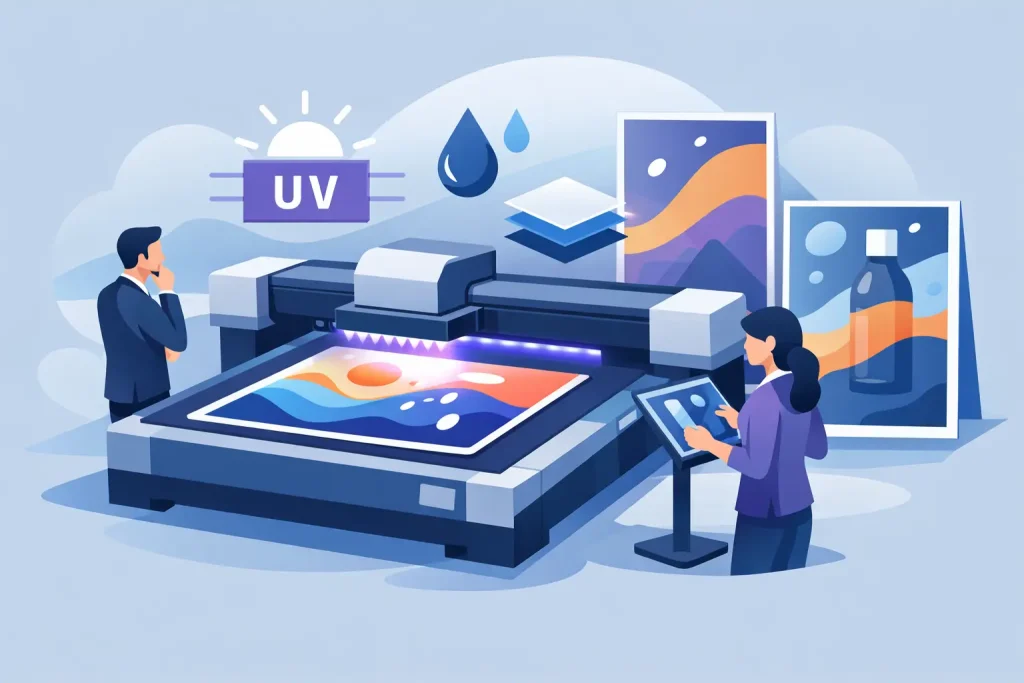
UV printing is a strong option for sharper output across a broader material range, including rigid media. It suits applications where crisp detail and material versatility are important. For storefront buyers managing mixed-format branding, UV can be useful because it supports different surfaces within one campaign.
Latex printing is often selected where low-odor output and flexible media compatibility are priorities. It can be a good fit for indoor retail graphics and window applications, particularly in environments where installation happens close to trading hours.
Dye sublimation is generally the better match for fabric displays rather than sticker or rigid board applications. It is useful for textile-based storefront extensions such as branded backdrops, soft signage, and promotional flags.
There is no single best method across every storefront job. A window sale decal, a backlit mall display, and a mounted entrance board may all require different production approaches even when they belong to the same campaign.
What buyers should check before ordering
The most common mistake in storefront branding is specifying the artwork before specifying the environment. Material selection should start with practical conditions: indoor or outdoor placement, sun exposure, moisture, lighting, campaign duration, and whether the graphic needs easy removal.
It also helps to think in viewing zones. A logo applied at eye level on glass needs different treatment from a large-format promotional panel seen from across a parking area. Small text, metallic finishes, and transparent media can all work well, but only when the viewing distance supports them.
For multi-location rollouts, consistency matters more than chasing special effects. A clean set of repeatable materials, such as white sticker media for windows, mounted board for counters, and lightbox film for illuminated areas, usually performs better than mixing too many specialty finishes. Buyers managing sites across Kuala Lumpur, Johor Bahru, or Penang often benefit from standardizing material choices so replacement and reordering stay simple.
A supplier with both display hardware and print production in one place can also reduce avoidable mismatch. If the same vendor handles the stand, frame, and graphic output, there is less risk of sizing issues, incompatible materials, or delays between separate production stages.
The right storefront branding material does not need to be complicated. It needs to fit the surface, hold up for the campaign period, and present the message clearly in real conditions. When those basics are handled properly, the storefront does what it is supposed to do – get seen, get understood, and support the sale.
Related Posts