If you are ordering banners, stickers, retail graphics, or exhibition panels, the solvent vs uv printing choice affects more than print quality. It changes where the graphic can be used, how long it lasts, what materials are suitable, and how the finished surface looks under real lighting and handling.
For business buyers, this is usually not a design question. It is a production question. A promotional sticker for short-term indoor use does not need the same print method as an outdoor barricade panel, and a roll-up stand insert does not behave like a rigid KT board or acrylic sign. The right process depends on substrate, placement, durability target, and budget.
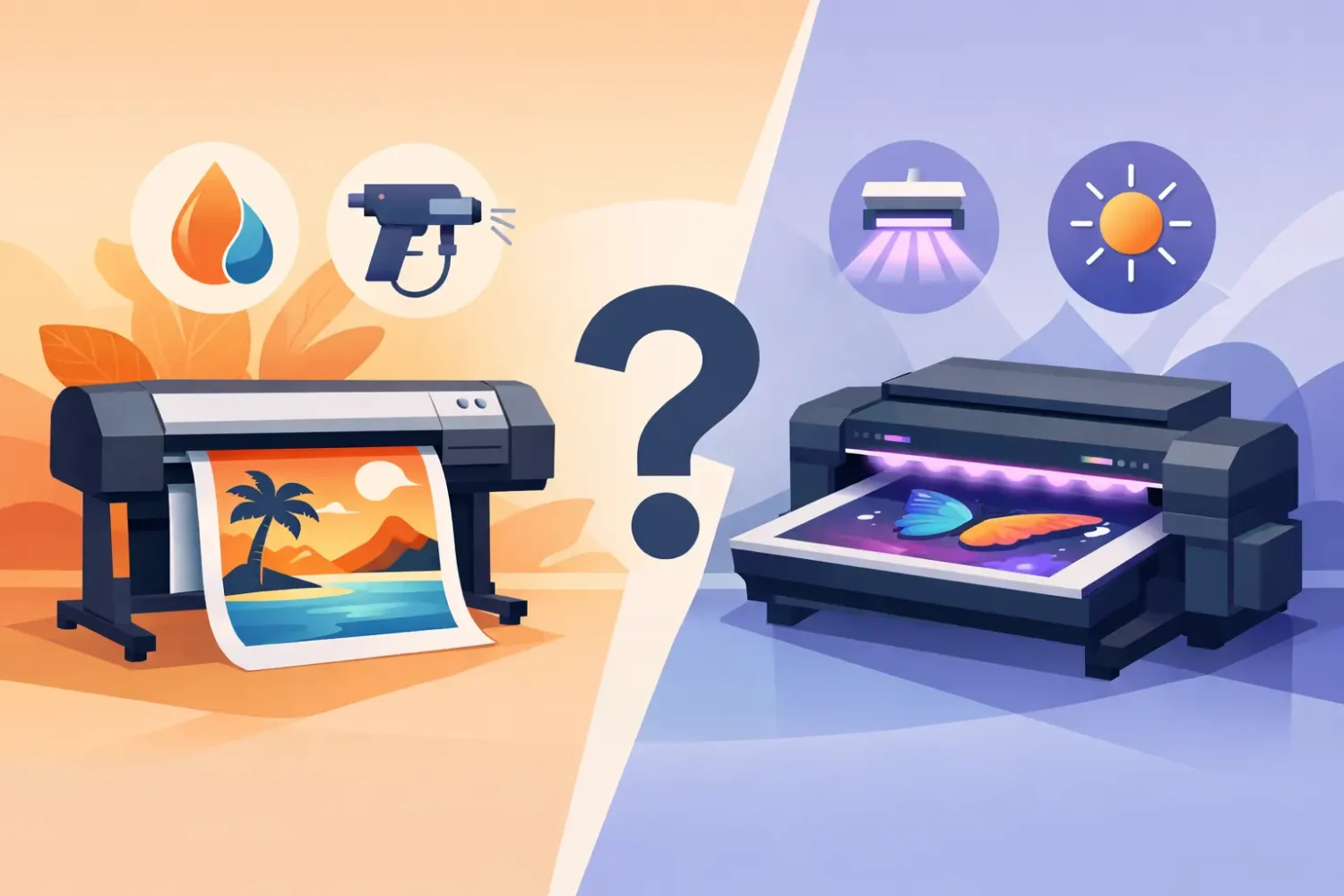
Solvent vs UV printing: the core difference
Solvent printing uses solvent-based inks that penetrate the media surface. It is commonly used on flexible roll materials such as banner, vinyl, and adhesive media. Because the ink bonds into the material, solvent printing is a standard option for outdoor signage, vehicle graphics, event banners, and large-format promotional pieces.
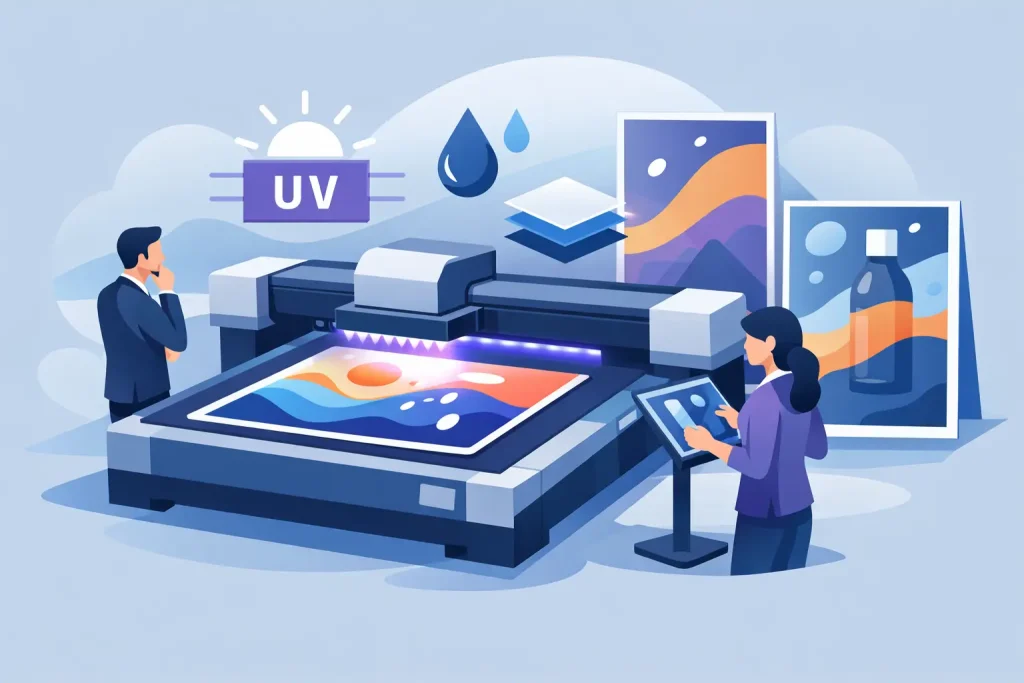
UV printing uses ultraviolet light to cure the ink immediately on the surface of the material. Instead of soaking in, the ink hardens on top of the substrate. This makes UV suitable for a wider range of materials, including rigid boards and some specialty surfaces, while also giving a more controlled finished appearance.
That difference in how the ink sets is what drives most of the trade-offs. Solvent tends to perform well on flexible media and outdoor applications. UV tends to be more versatile across material types and is often preferred when surface finish, sharp detail, or rigid printing is part of the job.
Where solvent printing makes the most sense
Solvent printing remains a practical choice for many commercial graphics because it is proven, cost-effective for volume, and compatible with common signage materials. If the job is a PVC banner, outdoor poster, self-adhesive vinyl, or long-run promotional graphic, solvent is often the straightforward answer.
For event and retail buyers, solvent works especially well when the output needs to be durable and flexible. A hanging banner, a fence mesh graphic, a roadshow backdrop, or a temporary storefront promotion often benefits from a print process that handles rolled media efficiently.
Another advantage is outdoor performance. Solvent prints are widely used for applications exposed to sun, rain, and general weathering. That does not mean every solvent print is identical in lifespan, because ink set, material grade, and lamination still matter, but the method has a strong track record for exterior use.
There are limits. Solvent is not the first choice for every rigid substrate, and if the application needs a very specific premium surface effect, the finish may not be as crisp or as controlled as UV on certain materials. Drying and outgassing considerations can also affect production timing in some workflows.
Where UV printing has a clear advantage
UV printing is often the better fit when material flexibility is less important than substrate range and surface presentation. Because the ink is cured instantly, UV can print on rigid media such as foam board, acrylic, PP board, KT board, and other display panels commonly used in retail, exhibitions, and indoor branding.
This matters when a campaign includes mixed formats. A buyer may need window decals, countertop signs, rigid promotional boards, and light frame visuals in the same rollout. UV gives more latitude across these kinds of substrates, which can simplify production planning.
UV also tends to deliver sharp text and defined graphics, especially on flat surfaces. For point-of-sale signage, product launch boards, branded counters, and display panels viewed at close range, that cleaner surface print can be a practical advantage.
The trade-off is that UV ink sits on the surface, so flexibility can become an issue depending on the media and end use. If a print needs to bend, roll, stretch, or be applied to a demanding curved surface, not every UV output will behave the same way. Material compatibility needs to be checked rather than assumed.
Print quality, finish, and viewing distance
In the solvent vs uv printing decision, buyers often ask which one looks better. The more useful answer is that each looks better in the right context.
For large banners and outdoor promotional graphics viewed from a distance, solvent output is typically more than sufficient. It produces strong color and solid commercial-grade results for standard advertising use. If the print is going on a beach flag, banner stand graphic, or building-facing visual, the practical difference may be less about absolute image sharpness and more about media suitability and durability.
UV stands out when the graphic is seen up close or printed on rigid presentation materials. Product boards, menu panels, indoor signs, branded display walls, and mounted graphics can benefit from the cleaner, surface-cured look. If a buyer is trying to present a more polished retail or showroom finish, UV often supports that goal better.
Still, finish is not only about the printer. The substrate matters just as much. A premium board printed in UV can look excellent, but a lower-grade material will still look like a lower-grade material. The same applies to solvent on good-quality vinyl or banner stock.
Durability and application environment
Application environment should decide more than personal preference. If the print will sit outdoors for extended periods, weather resistance and material pairing should lead the discussion. Solvent is a dependable option here, especially for banners, adhesive vinyl, and external promotional graphics.
UV also performs well in many durable signage applications, but the question is not simply whether UV is durable. It is whether the specific UV print on the specific substrate matches the use case. A rigid UV-printed board for an indoor mall campaign is a different product from a flexible outdoor banner.
For indoor branding, UV often has the edge because it supports clean presentation on rigid media and specialty stock. For outdoor flexible graphics, solvent frequently remains the more practical route.
If the job includes handling, packing, transport, and repeated setup, such as exhibition graphics and roadshow materials, durability should be judged as a full system. The print method, substrate, lamination, mounting, and display hardware all work together.
Cost considerations for commercial orders
Cost is never just about square-foot print rate. It includes material waste, finishing steps, installation needs, replacement cycle, and whether one print method supports all the formats in a campaign.
Solvent can be the more economical choice for common roll media and higher-volume signage. If the campaign needs multiple banners, adhesive graphics, and standard promotional prints, solvent often keeps production efficient.
UV may cost more in some cases, but it can reduce complexity when printing directly to rigid boards or specialty materials. That matters if the alternative would require mounting printed film to a panel or using multiple vendors. For procurement teams, fewer production stages can offset a higher print method cost.
This is where a supplier with both display hardware and print production options can be useful. If the same vendor can match the print method to the final format, whether that is a roll-up stand, popup display, LED light frame, counter, or KT board stand, the specification process gets cleaner.
How to choose between solvent and UV printing
The fastest way to make the right call is to start with the finished product, not the printer type. Ask what the graphic is, where it will be placed, how long it needs to last, and what material it needs to be printed on.
If the job is a flexible outdoor banner, event vinyl, or general-purpose adhesive graphic, solvent is usually a strong candidate. If the job is a rigid signboard, mounted promotional panel, or close-view retail display, UV is often the better fit.
If the project includes several formats, split the print method by application instead of forcing one method across everything. A trade show package, for example, might use solvent for large backdrop graphics and UV for rigid counters or shelf signage. That is often the most practical commercial answer.
For buyers managing campaigns across multiple cities, consistency matters as much as print type. A rollout in Kuala Lumpur, Johor Bahru, and Penang should use the same specification logic across locations so replacement and repeat orders stay simple.
The useful question is not which print method is better in general. It is which one matches the exact display format, substrate, and campaign condition you are buying for. When that part is clear, the print method usually follows without much debate.
Related Posts