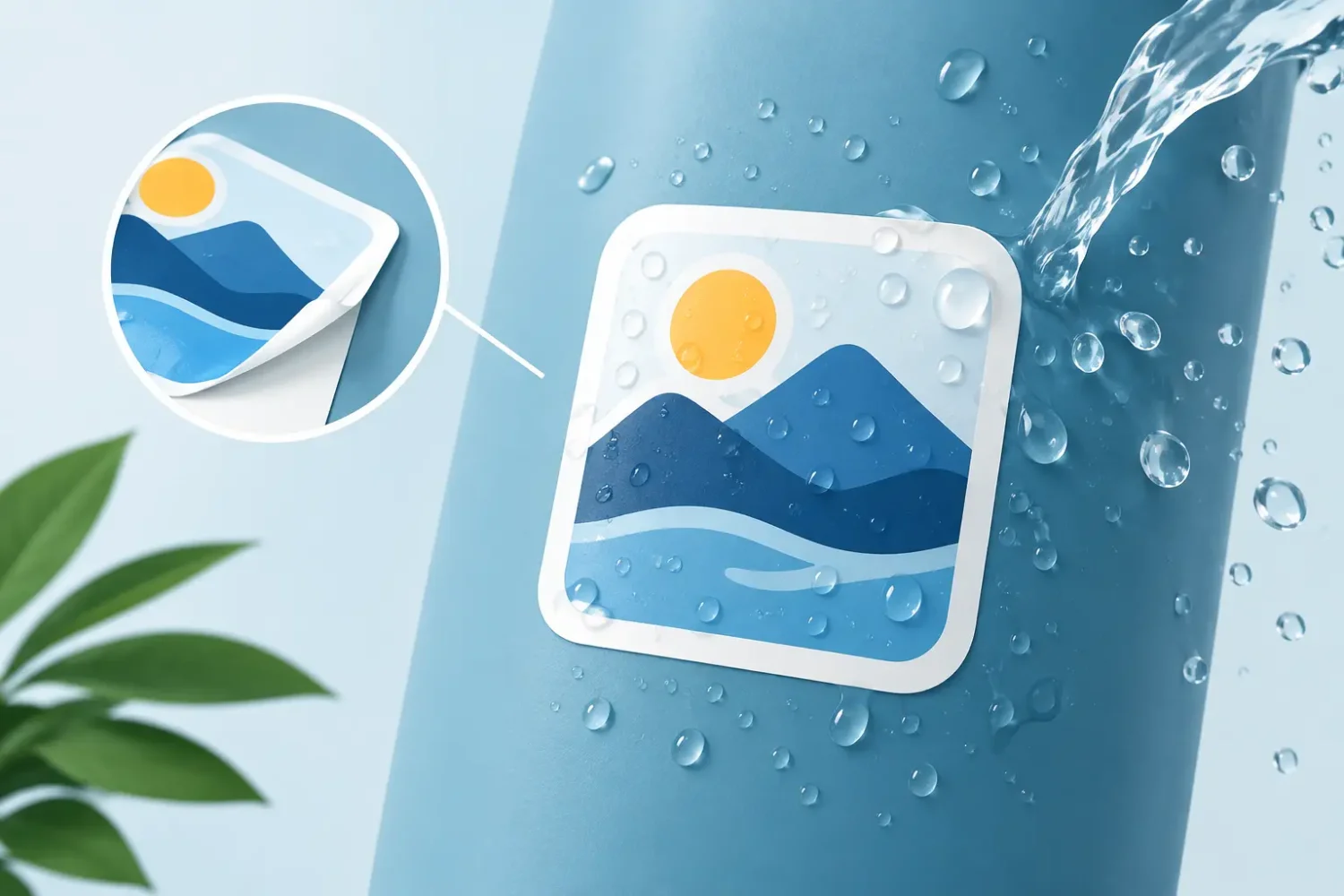
A bottle label that curls after refrigeration, a delivery sticker that smears in rain, or a window decal that lifts at the corners creates a problem that looks small but reflects directly on the brand. So, can synthetic stickers resist water? In most commercial applications, yes. But water resistance depends on more than selecting a material called “synthetic.” The print method, adhesive, finish, surface preparation, and exposure conditions all affect the result.
For business buyers ordering product labels, point-of-sale graphics, event stickers, or outdoor promotional materials, the practical question is not whether synthetic stock can get wet. It is whether the finished sticker will stay readable, bonded, and presentable for the required period of use.
Can Synthetic Stickers Resist Water? What the Material Does
Synthetic sticker materials are generally made from plastic films rather than paper. Common options include polypropylene (PP), polyethylene (PE), and polyester (PET). Unlike paper labels, these films do not absorb water, swell, or lose their basic shape when exposed to moisture. This gives them a clear advantage for chilled products, wet handling, splash zones, and short-term outdoor use.
PP white sticker stock is a common commercial choice because it provides a smooth printable face with good water resistance and flexibility. It suits packaging labels, promotional stickers, cosmetic containers, food containers, and many retail applications. Transparent synthetic film is useful when the container color or product needs to remain visible, while matt silver and hologram synthetic options are selected when the label needs a specialty visual effect.
The film itself may resist water, but that does not automatically make the completed sticker waterproof in every condition. A label on a dry indoor carton faces a very different environment from one applied to an ice bucket, a shampoo bottle, or an outdoor equipment case. The material must be specified for the job, not just selected by appearance.
Water-Resistant Is Not Always Waterproof
Water-resistant means a sticker can tolerate limited moisture, splashes, condensation, or occasional rain without immediate damage. Waterproof usually describes a higher level of performance, where the material, print, adhesive, and finish can withstand sustained water exposure. Neither term alone tells you how long the sticker will last or what chemicals it can tolerate.
For example, a synthetic label with suitable UV printing may perform well on bottled drinks stored in a refrigerator. The same label may fail sooner if it is repeatedly submerged, scrubbed with detergent, exposed to cooking oil, or placed on a rough low-energy plastic container. A waterproof requirement should always include the actual conditions: indoor or outdoor use, expected duration, direct rain, immersion, condensation, cleaning chemicals, abrasion, and temperature range.
This distinction matters for procurement. Ordering a standard synthetic sticker for a one-day roadshow is cost-effective. Ordering that same construction for reusable water bottles or industrial containers may result in edge lifting, print wear, or adhesive failure. The correct specification avoids reprints and prevents a campaign asset from looking poor before the campaign ends.
The Print Method Affects Water Performance
The printed image must resist water as well as the film does. Commercial print processes perform differently depending on ink chemistry and curing method.
UV printing is a strong option for synthetic stickers because the ink is cured onto the surface using ultraviolet light. The cured ink layer offers good color density and resistance to handling and moisture, particularly when paired with a suitable finish. It is often selected for branded labels, promotional decals, and stickers requiring sharp graphics.
Eco-solvent and solvent printing are widely used for durable graphics and can perform well on compatible vinyl and synthetic media. The ink bonds into or onto the coating of the printable film, producing suitable results for many signage and outdoor sticker applications. Drying and curing time still matter. Applying, laminating, or packing graphics before they have properly cured can reduce durability.
Latex printing can also be a practical choice for certain sticker films, with fast turnaround and good environmental performance characteristics. Dye sublimation is generally used for polyester fabric and display textiles rather than standard self-adhesive synthetic sticker stock. It should not be treated as a default sticker-printing method simply because the word “synthetic” appears in both material categories.
Lamination Adds Protection Where It Is Needed
For labels exposed to regular handling, moisture, friction, or outdoor conditions, lamination is often the feature that changes a water-resistant sticker into a more dependable finished product. A clear gloss or matte laminate creates a protective face layer over the printed image. It reduces scuffing, helps protect ink from cleaning splashes, and limits moisture entry through the printed surface.
Gloss lamination gives colors more visual impact and is frequently used for product labels and promotional graphics. Matte lamination reduces glare and gives a more understated finish, useful for premium packaging, instruction labels, and surfaces viewed under strong retail lighting. The choice is visual, but also operational: both can add a useful protection layer when the correct laminate and adhesive are used.
Lamination is not mandatory for every synthetic sticker. A short-term indoor label may not need it, and omitting it can reduce cost and production time. For a sticker that will be handled repeatedly or used outdoors, it is usually worth discussing during quotation rather than adding only after failure occurs.
Adhesive Is Usually the Weak Point
When a synthetic sticker fails around water, the adhesive is often the issue rather than the face film. Moisture can work into unsealed edges, especially where the sticker was applied to a wet, dusty, oily, textured, or curved surface. Condensation can also prevent proper adhesive contact from the start.
Permanent adhesive is appropriate for most labels that need to remain in place for the life of a product or campaign. Removable adhesive is useful for temporary retail promotions, window graphics, and short-term event identification, but it is not designed for the same long-term holding strength. High-tack or specialty adhesives may be needed for challenging substrates such as powder-coated surfaces, rough plastics, or low-energy plastics including some polypropylene and polyethylene containers.
Before application, the surface should be clean, dry, and free of oil, silicone, dust, and residue. Apply the sticker with firm, even pressure, paying attention to edges and corners. For curved bottles or containers, select a flexible film and avoid forcing a stiff sticker over tight curves. If labels are applied in a cold room, allow both the container and label to reach the recommended application temperature where possible.
Specify the Exposure Before Ordering
A supplier can recommend a more suitable construction when the end use is stated clearly. “Waterproof sticker” is a starting point, not a complete production specification. Include the material surface, location, expected lifespan, and the type of water or cleaning exposure.
For an accurate quote or production recommendation, provide these details:
- The application surface, such as glass, metal, plastic, coated board, or painted wall.
- Whether the sticker faces condensation, rain, washdown, direct immersion, or cleaning chemicals.
- Indoor or outdoor placement and the expected campaign duration.
- Required finish, including gloss, matte, transparent, white, hologram, or matt silver.
- Artwork size, quantity, cutting shape, and whether individual labels or sheets are required.
This information is especially useful for retail operators, event teams, and agencies coordinating several formats at once. A campaign may use synthetic stickers on product packaging, vinyl graphics on counters, UV-printed panels for displays, and fabric graphics for a popup system. Each material should be selected according to its actual environment rather than given one blanket durability claim.
Typical Applications for Synthetic Stickers
Synthetic stickers are a practical fit for refrigerated packaging, bottled products, personal care containers, takeaway packaging, warehouse identification, short-term outdoor promotions, retail shelf communication, and event equipment labels. They are also useful for decals that need to survive rain during roadshows or outdoor activations.
They may be the wrong choice when a label needs to withstand frequent hot-water washing, aggressive solvents, prolonged underwater use, or years of direct sun exposure. In those cases, a higher-grade film, specialized adhesive, protective laminate, or alternative marking process may be required. The lowest-cost sticker is not always the lowest-cost solution if replacement labor, damaged inventory, or inconsistent branding is involved.
For dependable results, treat synthetic stickers as a finished construction: film, ink, adhesive, and protection working together. Match that construction to the real exposure, and the sticker has a much better chance of staying clean, attached, and readable throughout its intended use.
Related Posts