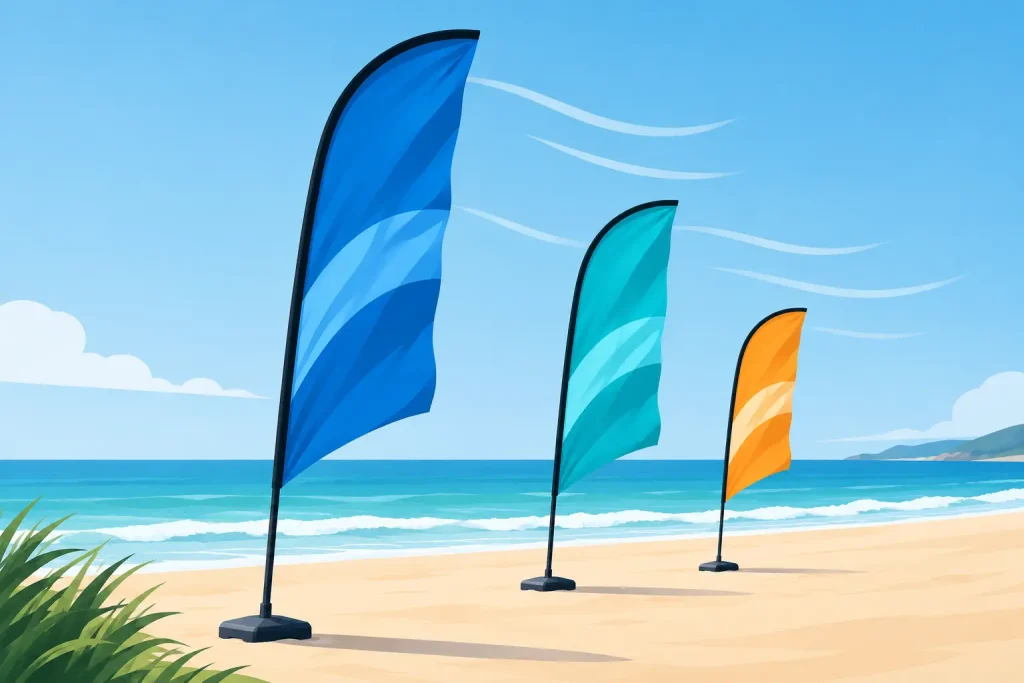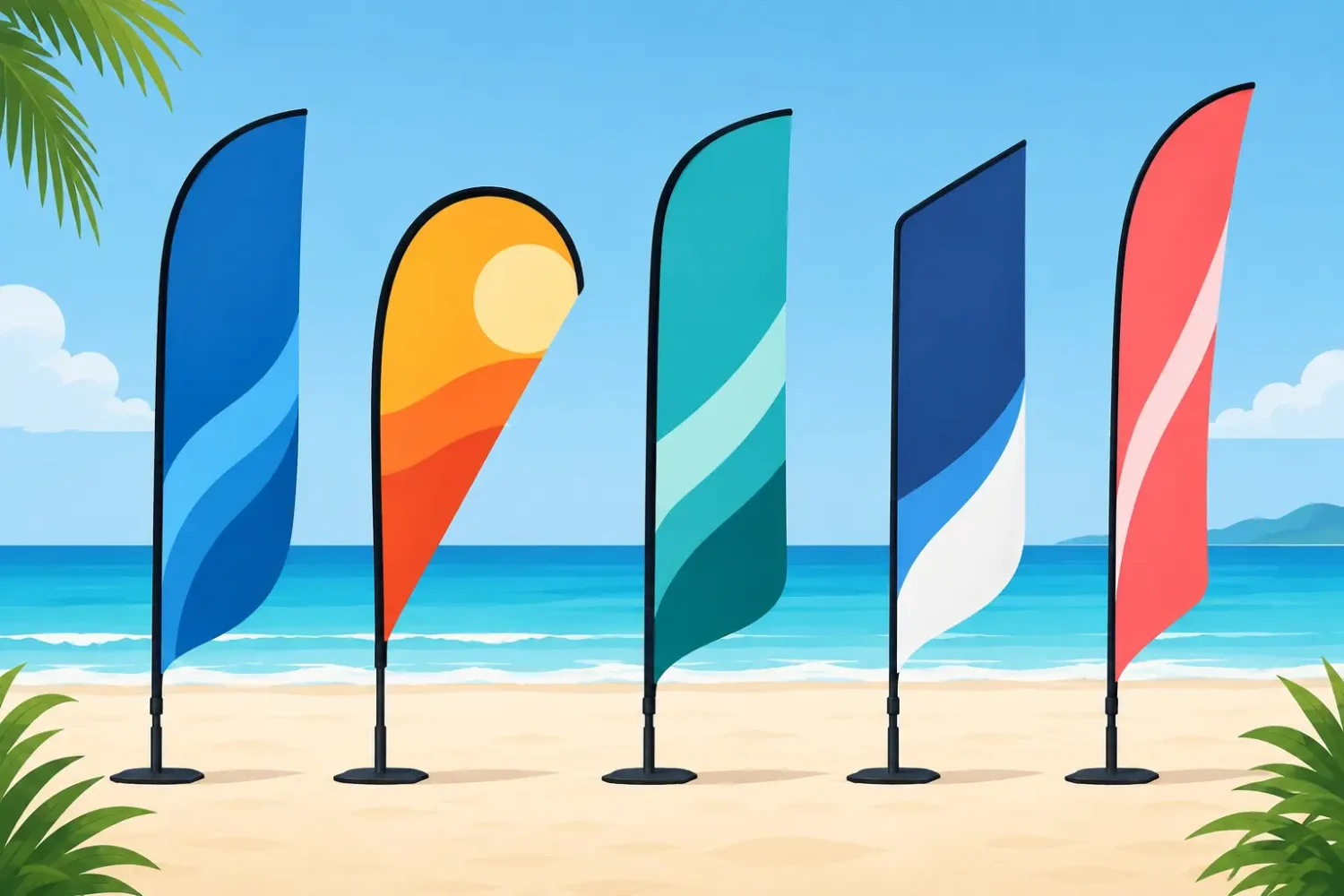
A beach flag can be seen before a visitor reaches your booth, storefront, or promotion area. That is why choosing the best custom beach flag shapes is not only a design decision. The shape affects how much copy fits, how the graphic reads from a distance, how the flag moves in wind, and which location it suits.
For business use, the right answer depends on the campaign. A retail opening needs a different flag than a roadshow, a food festival, or a trade show entrance. Start with the message you need people to see first, then choose the flag profile around it.
Best Custom Beach Flag Shapes by Campaign Need
Most custom beach flags use a flexible pole, printed fabric, and a base selected for the installation surface. The printed flag shape is what creates the visual profile. While product names can vary by supplier, the main commercial formats are feather, teardrop, rectangular, and angled or blade-style flags.
Feather flags for tall, moving visibility
Feather flags have a curved outer edge and a tapered top. They are one of the most common choices for retail promotions, property launches, automotive events, and outdoor activations because the tall profile is visible over crowds, parked vehicles, and temporary display equipment.
This shape works well when the design has a clear vertical hierarchy: logo at the top, a short offer or category message in the center, and a call to action lower down. It has a generous printable area, but the taper means long horizontal headlines can look cramped near the top.
Use feather flags when your main requirement is height and attention. They are especially practical in a row outside a storefront or lining the approach to an event. Keep the copy short. A logo, “NOW OPEN,” “SALE,” “REGISTER HERE,” or a directional message will generally perform better than a full product description.
Teardrop flags for a controlled graphic shape
Teardrop flags have a rounded top and a compact, enclosed profile. Unlike a feather flag, the fabric remains relatively readable as it moves because the pole and tension help hold the overall shape. This makes teardrop flags a strong option for outdoor use where breezes are expected.
The trade-off is printable space. A teardrop flag gives less room for stacked copy, particularly near the curved upper section. It is best for a large logo, bold icon, simple campaign name, or a single promotional message.
For event organizers, teardrops are useful at registration points, sponsor zones, sports events, and pop-up promotions where visual consistency matters. Their rounded outline also looks clean in pairs. Place one on each side of an entrance, counter, or product demonstration area for a more defined setup.
Rectangular flags for maximum message area
Rectangular beach flags, sometimes called block flags or straight flags, provide the closest thing to a vertical banner on a flexible pole. Their straighter edge creates a larger and more consistent print area from top to bottom.
This is usually the best format when the graphic includes a logo, headline, offer, product image, and QR code or contact detail. The shape also suits directional messaging because arrows and words such as “ENTRANCE,” “PARKING,” “CHECK-IN,” or “PROMOTION” remain easy to set in a clear reading order.
The rectangular shape is less dynamic than a feather flag, and its broader surface may catch more wind. It is still a practical choice for malls, exhibitions, covered walkways, showrooms, and retail frontage where the environment is more controlled. If campaign information matters as much as visual impact, choose this shape.
Angled and blade flags for modern campaign graphics
Angled or blade-style flags use a sharper top line than a standard feather profile. They are often selected for brands that want a more technical, active, or contemporary look. Fitness brands, automotive promotions, technology launches, and sports-related campaigns can benefit from the more aggressive silhouette.
Functionally, these flags sit between feather and rectangular styles. They can support a strong vertical message while giving the design more visual character. However, this is not the first choice for dense copy. The angled top can reduce usable space, especially if your artwork needs legal text, multiple sponsor logos, or detailed pricing.
Choose an angled profile when the campaign is image-led and the brand already uses sharp lines or directional graphic elements. A clean logo, one large product visual, and a short headline are enough.
Match the Flag Shape to the Viewing Distance
A flag is not read at the same distance as a brochure or a counter card. People may first see it from across a parking lot, along a walkway, or from the other end of an exhibition hall. The shape should support the viewing distance, not compete with it.
For long-distance visibility, a tall feather flag with a large logo and high-contrast headline is often the practical choice. For medium-distance promotion at an entrance or booth perimeter, teardrop and angled flags create a clear branded marker. For close-range messaging, a rectangular flag can carry more information without forcing the text into small type.
Do not treat every flag as a full advertisement. A beach flag is usually a traffic-stopping display, not a catalog page. If the message requires specifications, pricing tiers, or detailed product benefits, place those details on a roll-up stand, counter graphic, flyer, or wall display nearby.
Print Layout Matters as Much as the Shape
The most effective beach flag artwork follows the flag contour. Artwork that ignores the taper, curve, or angled top can look distorted or leave important copy too close to the edge.
Keep logos and text inside the safe area supplied for the selected flag template. Avoid placing key information along the pole sleeve or near the outer edge, where folds and movement can affect readability. A high-resolution logo and bold vector graphics are preferable to small photos with fine detail.
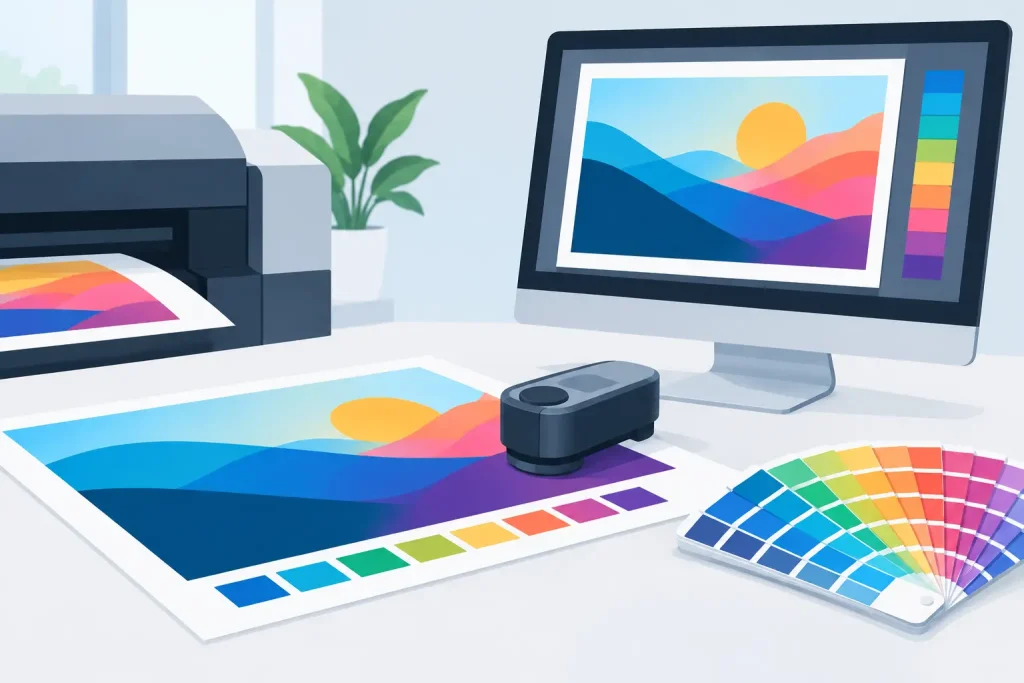
Color selection also matters outdoors. Strong contrast gives the best visibility. Dark lettering on a pale background, or pale lettering on a solid dark background, will read better than low-contrast brand colors placed together. If the flag will be used under bright sun, avoid relying on subtle gradients to carry the message.
For double-sided flags, ask how the two printed sides are produced and whether a block-out layer is included. Without an effective blackout layer, the image from one side can show through the other and reduce color clarity. Double-sided printing is useful when people approach from both directions, but it adds cost and weight. A single-sided flag may be sufficient when the display faces one primary traffic flow.
Select the Base for the Actual Installation Surface
A premium printed flag still fails if the base does not suit the site. Base selection should be part of the initial order, not an afterthought.
A cross base is commonly used indoors or on hard, level surfaces and can be paired with a water bag for additional stability. A square steel base offers a heavier, more permanent feel for showrooms, malls, and entrance areas. Ground spikes work for grass, soil, or sand, while screw bases are suitable for firmer outdoor ground. For beach or loose-soil installations, use hardware designed to anchor securely rather than relying on a lightweight indoor base.
Consider wind exposure honestly. A flag that performs well in a covered event space may need a heavier base, lower pole height, or more protected placement on an open outdoor site. Wind conditions, local venue rules, and the size of the flag all affect the correct hardware choice.
Choose Size Based on the Space, Not Just Visibility
Taller flags generally attract more attention, but the largest option is not automatically the best option. A very tall flag can overpower a small storefront, block sightlines at a booth, or become difficult to manage in low-ceiling venues.
For indoor exhibitions and compact retail areas, a medium-height flag is often enough to identify the space without crowding it. Larger flags are better suited to roadside promotions, outdoor markets, vehicle lots, sports grounds, and wide event entrances.
When ordering multiple flags, consistency is more valuable than mixing shapes without a reason. Use matching heights and bases for a formal retail or corporate setup. Use different shapes only when they have different jobs, such as tall feather flags for wayfinding and rectangular flags at the booth for offer details.
A Practical Buying Check Before Production
Before approving a custom beach flag order, confirm the final flag shape, visible print area, pole height, base type, print side, and intended installation surface. Also check whether the artwork is supplied in the correct template and whether the message can be understood in a few seconds.
My Inkjet can support buyers who need both beach flag hardware and printed graphics as part of a larger display requirement, including roll-up stands, counters, and event presentation materials. Keeping the display structure and print production aligned helps reduce mismatched sizes and last-minute setup issues.
The best flag shape is the one that makes the message obvious at the point where customers first notice it. Choose feather for height, teardrop for a compact outdoor marker, rectangular for more content, and angled profiles for a sharper campaign look. Then give the design enough space to do one job well.
Related Posts