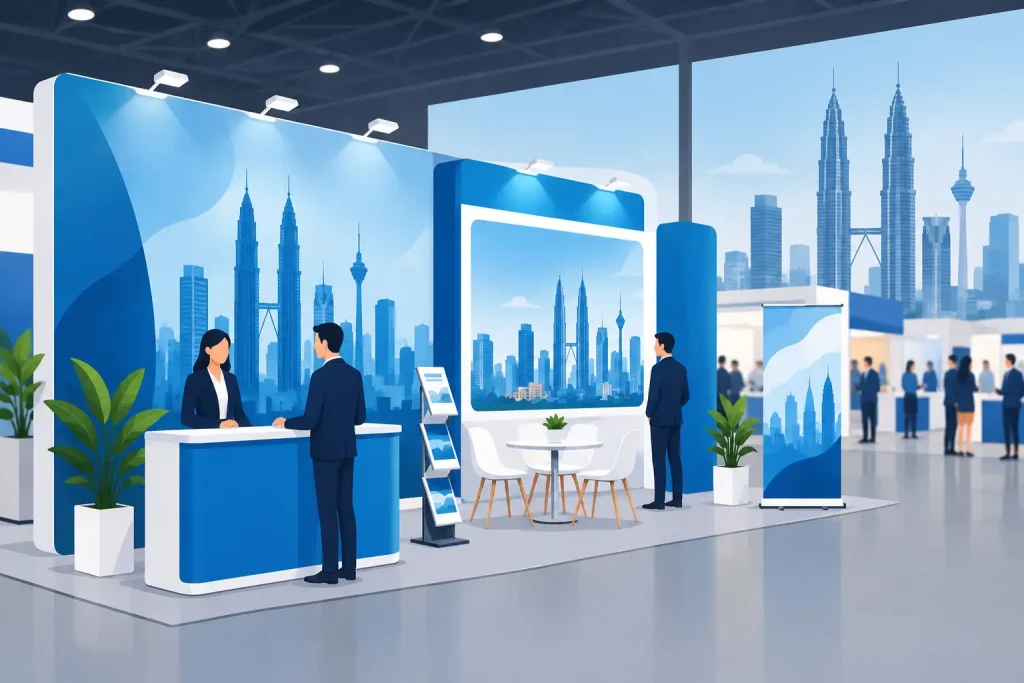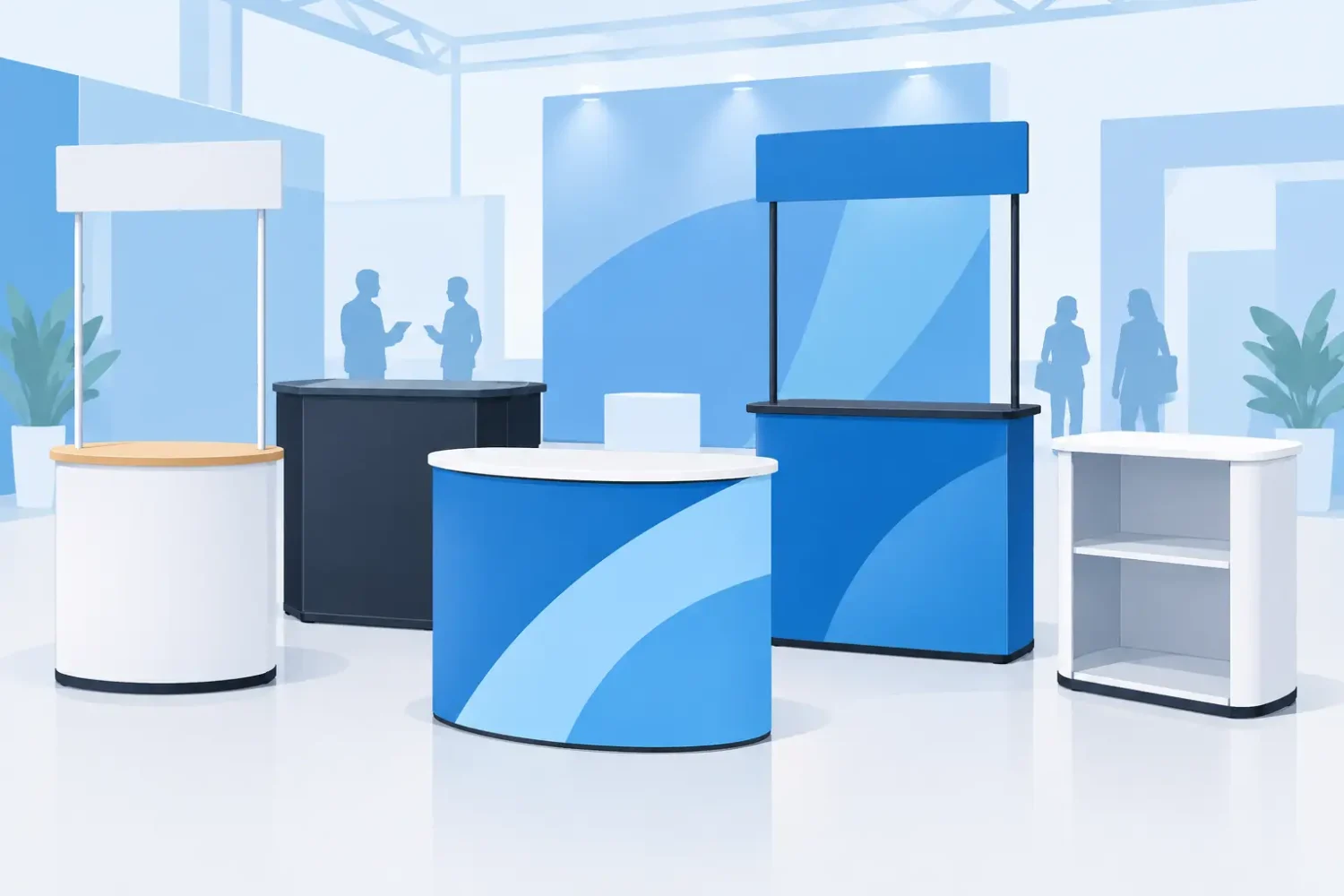
A booth counter has to do more than hold brochures. It becomes the first point of contact for registration, product sampling, payment, lead capture, or a product demonstration. The best portable booth counters balance a clean branded front panel with practical working space, quick transport, and a setup process that does not slow down an event crew.
For trade shows, mall promotions, roadshows, and retail activations, there is no single counter format that suits every campaign. A lightweight counter may be right for a one-day sampling activity, while an aluminum-frame unit is better for a premium launch that will be used repeatedly. Start with the job the counter must perform, then match the hardware, graphic material, and print finish to that requirement.
What Makes a Portable Booth Counter Worth Buying
A portable counter should be easy to carry, stable when assembled, and large enough for its intended work. A counter used for collecting visitor registrations needs a clear, usable countertop. A counter used for product sampling may need more load capacity and room for stock below. If the counter is only a visual touchpoint beside a roll-up stand or popup display, a smaller format can be more efficient.
Graphic replacement matters as well. Campaigns change, pricing changes, and event messaging is often location-specific. Counters with replaceable printed panels allow the hardware to stay in service while the visual message is updated. This reduces the cost of future activations and keeps the display system useful across different promotions.
Transport is the other deciding factor. Check whether the counter packs into a carry bag, wheeled case, or rigid transport case. A compact packed size helps when the same team is moving banners, brochures, product samples, and other display hardware at the same time.
7 Best Portable Booth Counters by Use Case
1. Fabric Popup Counter for Fast Event Setup
A fabric popup counter is a practical choice for marketers who need a branded counter with minimal assembly. The collapsible frame opens quickly, while the stretch-fabric graphic creates a clean front surface with no visible panel joins in many configurations. It works well for trade show reception points, lead collection, and product demonstrations where visual consistency with a fabric popup backdrop is required.
Its main advantage is speed. The trade-off is that fabric should be packed clean and handled carefully to avoid creasing or staining. For indoor events with repeated use, this is often one of the most efficient formats.
2. Curved Promotional Counter for Customer-Facing Activations
A curved counter gives the booth a softer, more welcoming front profile than a standard rectangular unit. It is useful for retail activations, sampling stations, and mall roadshows where staff will stand behind the counter and speak directly with passing customers.
The curved front also gives the printed graphic more visual presence from an angle. Choose this format when the counter is a visible feature of the activation rather than just a support surface. Confirm the tabletop depth before ordering, especially if the team needs to place laptops, payment devices, or product trays on top.
3. PVC Panel Counter for Budget Campaigns
A PVC panel counter is suited to short-term promotions and standard event use. The panels are lightweight, easy to print, and can deliver sharp color for promotional graphics, logos, and product images. This makes the format suitable for campaigns that require several counters across multiple locations.
The main consideration is durability. PVC panel counters are practical for controlled indoor use, but they are not the best choice for heavy daily handling, wet environments, or rough logistics. Use a protective carry bag and avoid placing excessive weight on the tabletop.
4. Aluminum Frame Counter for Repeated Commercial Use
An aluminum frame counter is the better fit when the display will travel regularly between exhibitions, showrooms, roadshows, and retail sites. The frame provides a more structured build, while the graphic panel can be produced separately to match the campaign design.
This type of counter usually carries a higher initial cost than a simple panel system. However, it can be a better long-term purchase for companies, agencies, and exhibition suppliers that use the same hardware throughout the year. It also pairs naturally with aluminum frame backwalls, SEG fabric graphics, and LED light frame displays.
5. Rectangular Folding Counter for Product Demonstrations
A rectangular folding counter prioritizes working space. Its straightforward shape makes it suitable for demonstrators who need room for sample units, catalogs, small appliances, cosmetics, or packaged products. It is also easier to position against a booth wall when floor space is limited.
This format is less decorative than a curved or illuminated counter, but it is highly functional. A strong full-front graphic can still create a professional branded appearance. Select a wider model when staff need to work side by side, or when the countertop must support more than brochures and a tablet.
6. Hard Case Counter Conversion for Mobile Teams
Some transport cases can convert into branded counters once they reach the venue. This option is useful for teams that already need a rigid case to move display hardware safely. Instead of bringing a separate counter and case, the case performs both jobs.
It is a sensible choice for frequent roadshows, especially where setup crews travel light. The limitation is design flexibility: the available countertop size and counter shape are determined by the case format. For a simple registration point or product handout station, that may be enough.
7. LED Counter for Premium Product Launches
An LED counter adds illumination behind the printed graphic, making it suitable for premium retail displays, technology launches, beauty promotions, and evening events. Light helps the branding stand out in a busy hall, particularly when nearby exhibitors are also using illuminated frames and backlit signage.
This is not the lowest-cost portable option, and it requires access to power. It should be chosen for impact, not simply because it is available. Use high-resolution artwork with considered color density, since graphics that look acceptable on a standard printed panel can appear different when backlit.
Match the Counter to the Booth Layout
The counter should support the rest of the display, not block it. For a compact 10-foot booth, a small counter placed near one front corner can leave the main graphic wall visible and preserve a clear entry path. A large counter placed across the full front may work for sampling or registration, but it can create a barrier when the goal is conversation.
Consider where visitors will stand, where staff will store materials, and how cables will be managed if tablets, screens, or lighting are involved. If a counter is intended for a retail environment, measure the available floor area and check sightlines from the aisle. A well-printed counter has limited value if customers cannot approach it comfortably.
Choose the Right Print and Graphic Finish
Counter graphics are viewed at close range. Small type, low-resolution logos, and poorly prepared images are more noticeable here than on a distant banner. Supply artwork at the correct size and use high-resolution images suitable for large-format production.
For rigid panels, UV printing can be a practical option where direct print durability and strong color are required. For flexible graphics, latex, eco-solvent, solvent, or dye sublimation production may suit the material and finish selected. The right method depends on the chosen substrate, expected use, color requirement, and whether the graphic needs to wrap around a curved surface.
Keep the design focused. A logo, one campaign message, a product image, and clear contact or promotional information generally work better than filling every part of the front panel with text. The counter is often seen while a visitor is walking past, so the message must be readable in seconds.
Before You Order a Portable Counter
Confirm the operational details before approving artwork and hardware. A few checks prevent avoidable problems at the venue:
- Measure the counter footprint, countertop height, and usable work surface.
- Confirm packed size, carry bag or case inclusion, and total transport weight.
- Check whether shelves, internal storage, doors, or cable access are needed.
- Ask whether graphics are replaceable and whether replacement panels can be ordered later.
- Verify the recommended load capacity before placing products or equipment on top.
- Match the graphic material and print method to indoor, outdoor, short-term, or repeated-use conditions.
If the counter will be used with a popup display, roll-up stands, beach flags, or an LED light frame, coordinate the artwork before production. Matching logos, colors, image treatment, and message hierarchy makes standard display hardware look like one complete booth system rather than separate items placed together.
The right portable counter is the one that gives staff a usable workspace while presenting the campaign clearly from the aisle. Choose the format based on how the team works at the event, then invest in graphics that make the counter earn its floor space.
Related Posts