A menu placed behind a front window can be missed by people deciding where to eat. A clear board at the entrance gives them the information they need before they walk in: what is available, what it costs, and what is worth ordering today. The best outdoor menu boards do that job in sun, rain, wind, and high foot traffic without looking temporary or becoming difficult to update.
For restaurants, cafes, food kiosks, bars, bakeries, and retail counters with takeaway offers, the right choice is less about finding one universal board and more about matching the format to the operating environment. A daily-specials cafe has different requirements from a quick-service restaurant with a fixed menu, and both differ from a mall storefront with covered frontage.
What Makes the Best Outdoor Menu Boards Work
An outdoor menu board must be readable before it is decorative. Customers often view it while walking, waiting in line, or standing several feet from the entrance. Small type, low contrast, reflective surfaces, and crowded layouts slow down the decision. That can mean a lost walk-in customer, especially during busy meal periods.
Start with viewing distance. A board read from the sidewalk needs larger menu categories, item names, and prices than one positioned beside an ordering window. Keep the most profitable or popular items near the upper half of the display, where the eye naturally lands first. Use high-contrast color combinations, such as dark lettering on a light background or white lettering on a dark background. Brand colors still matter, but they should not reduce legibility.
Weather resistance is the second requirement. Outdoor use exposes hardware and printed graphics to ultraviolet light, humidity, rain, dust, and accidental knocks. A board does not need the same construction level in every location. A covered patio can use a lighter changeable display, while a roadside storefront needs a more stable, enclosed system.
The third requirement is update speed. If prices, availability, promotions, or meal sets change regularly, a permanently printed panel can create unnecessary reprint costs. If the menu stays stable for months, a fixed printed graphic is cleaner and easier to manage.
Choose the Right Outdoor Menu Board Format
Wall-Mounted Menu Boards
Wall-mounted boards suit businesses with a permanent entrance, service window, drive-up area, or exterior wall visible from the street. They use space efficiently and create a more established appearance than a freestanding sign. They are a practical option for fixed menus, operating hours, category boards, or combination panels showing both food and promotional content.
For exposed locations, use a weather-resistant frame and a graphic substrate selected for outdoor conditions. UV printing is useful where strong color, sharp text, and good resistance to fading are required. Laminated printed panels can add protection against moisture, scratches, and frequent cleaning.
The trade-off is flexibility. A wall-mounted board looks professional, but moving it or changing a complete printed menu requires more work. It is best when the menu structure is stable and the location has predictable traffic flow.
Freestanding A-Frame and Sandwich Boards
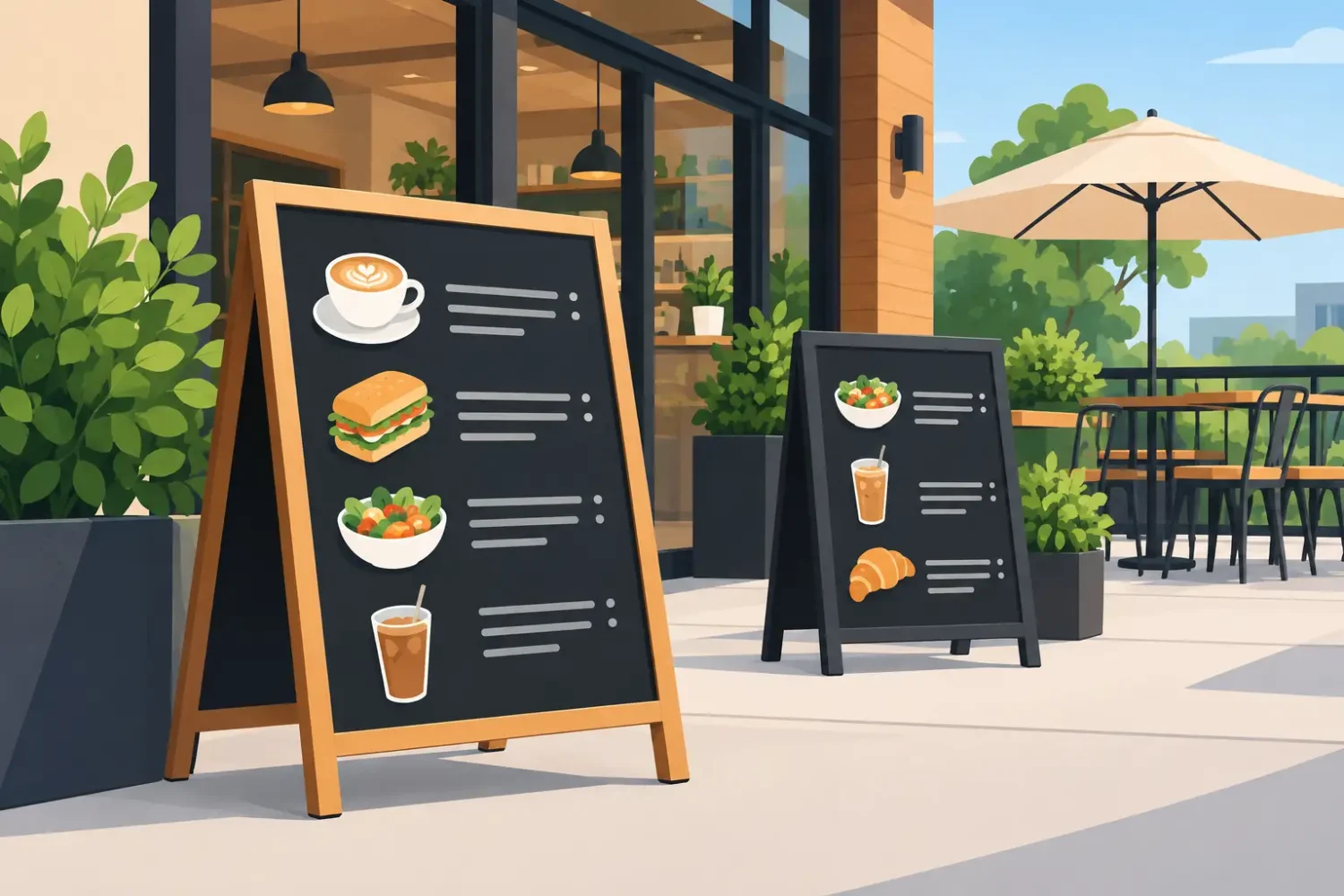
A-frames are among the most useful outdoor menu formats for cafes, restaurants, pop-up counters, and stores that need to capture passing traffic. Position one near the entrance, at a sidewalk edge where permitted, or beside a queue to promote specials and guide customers toward ordering.
These boards work particularly well for short, timely messages: lunch sets, seasonal drinks, limited desserts, happy-hour pricing, or a simple QR ordering prompt. A replaceable insert design gives staff more flexibility than a fully fixed panel. Chalkboard-style surfaces can work for handwritten daily specials, although they are less suitable when consistent brand presentation and long-distance readability are priorities.
Stability matters. Select a frame with enough weight and a wide enough footprint for the local wind conditions. Lightweight boards are easy to move, but they can become a safety issue in exposed walkways. For high-traffic commercial sites, use durable hardware with protected corners and a surface that can be wiped down quickly.
Enclosed Poster Cases
An enclosed poster case is a strong choice for menus that need protection from rain, dust, tampering, or repeated handling. The menu is displayed behind a clear cover, usually with a locking or secured frame. This format is common for restaurant entrances, hotel dining areas, food courts, golf clubs, and venues with more formal presentation requirements.
It provides a controlled, tidy finish for printed menu sheets and campaign posters. Staff can replace the insert when required without replacing the whole unit. Make sure the front cover does not create excessive glare in direct sunlight. Placement under an awning or on a wall that avoids strong afternoon sun can improve visibility.
Digital Outdoor Menu Boards
Digital displays are appropriate when menu content changes frequently by time of day, stock level, promotion, or location. They can display breakfast menus in the morning, lunch offers at noon, and dinner combinations later without manual panel swaps. They are also useful for businesses running multiple promotional messages on one screen.
However, digital is not automatically the best answer. Outdoor-rated screens require proper brightness, ventilation, power access, weather-rated enclosures, and ongoing content management. Initial cost is higher, and a poorly positioned screen can be hard to read in direct sunlight. For a business with a stable menu and a single entrance, a professionally printed board may deliver a better return.
Materials and Print Choices That Hold Up Outside
The board structure and the printed graphic need to be specified together. A good frame cannot compensate for an unsuitable print material, and a high-quality print will not last if the hardware allows water to enter or the board to flex excessively.
For rigid menu panels, common options include PVC-based boards, aluminum composite panels, acrylic, and other mounted display materials. Aluminum composite is often selected for permanent external signage because it is flat, durable, and suited to printed graphics. PVC can suit lighter-duty applications and protected outdoor areas. The right thickness depends on panel size, mounting method, and wind exposure.
For graphics, UV printing is a practical choice for rigid panels and outdoor display applications. It produces crisp text and can print directly onto many substrates. Eco-solvent and solvent print methods are also commonly used for outdoor graphics, especially on suitable vinyl media. Laminating the print adds another layer of protection and makes routine cleaning easier.
Do not choose a material based only on its appearance when new. Ask how it will perform after months of sun, rain, cleaning, and customer contact. A matte finish can reduce glare, while glossy surfaces may make colors appear more vivid but reflect more light. For menus, readability usually matters more than shine.
Plan the Menu Layout Before Printing
A menu board is an operational tool, not just an exterior sign. Build the layout around how customers order. Use clear sections such as coffee, meals, sides, desserts, beverages, or combos. Avoid placing every item in the same visual weight. A customer should be able to identify the main categories in seconds.
Keep prices aligned consistently. Use photographs only when they help sell a featured item, since too many product images can make the board feel crowded. Include dietary symbols or short notes where needed, but avoid turning the menu into a block of fine print.
Leave room for change. Businesses with seasonal products can reserve one panel or one poster slot for current offers while keeping the core menu permanent. This reduces waste and keeps the entrance active without forcing a complete redesign. My Inkjet can support this approach by supplying both display hardware and printed menu graphics as part of the same order process.
Installation and Maintenance Affect the Result
Even well-produced menu boards fail when installed in the wrong place. Check sightlines from both directions of foot traffic. Keep the display clear of parked vehicles, planters, open doors, and queue barriers. If customers must stand in bright sun to read it, consider a different angle, a matte graphic, or a shaded placement.
Clean the display regularly with materials suitable for the surface. Dust, fingerprints, water marks, and faded inserts make a business appear less organized than the menu itself. Check frames, hinges, fasteners, and bases after heavy weather, particularly for freestanding units.
Choose a menu board that matches the pace of your operation. A fixed wall panel suits a stable menu and permanent site. An A-frame supports daily promotions. An enclosed case protects printed inserts. A digital board earns its cost when content changes often enough to justify it. The best choice is the one customers can read quickly, staff can manage reliably, and your location can support year-round.
Related Posts