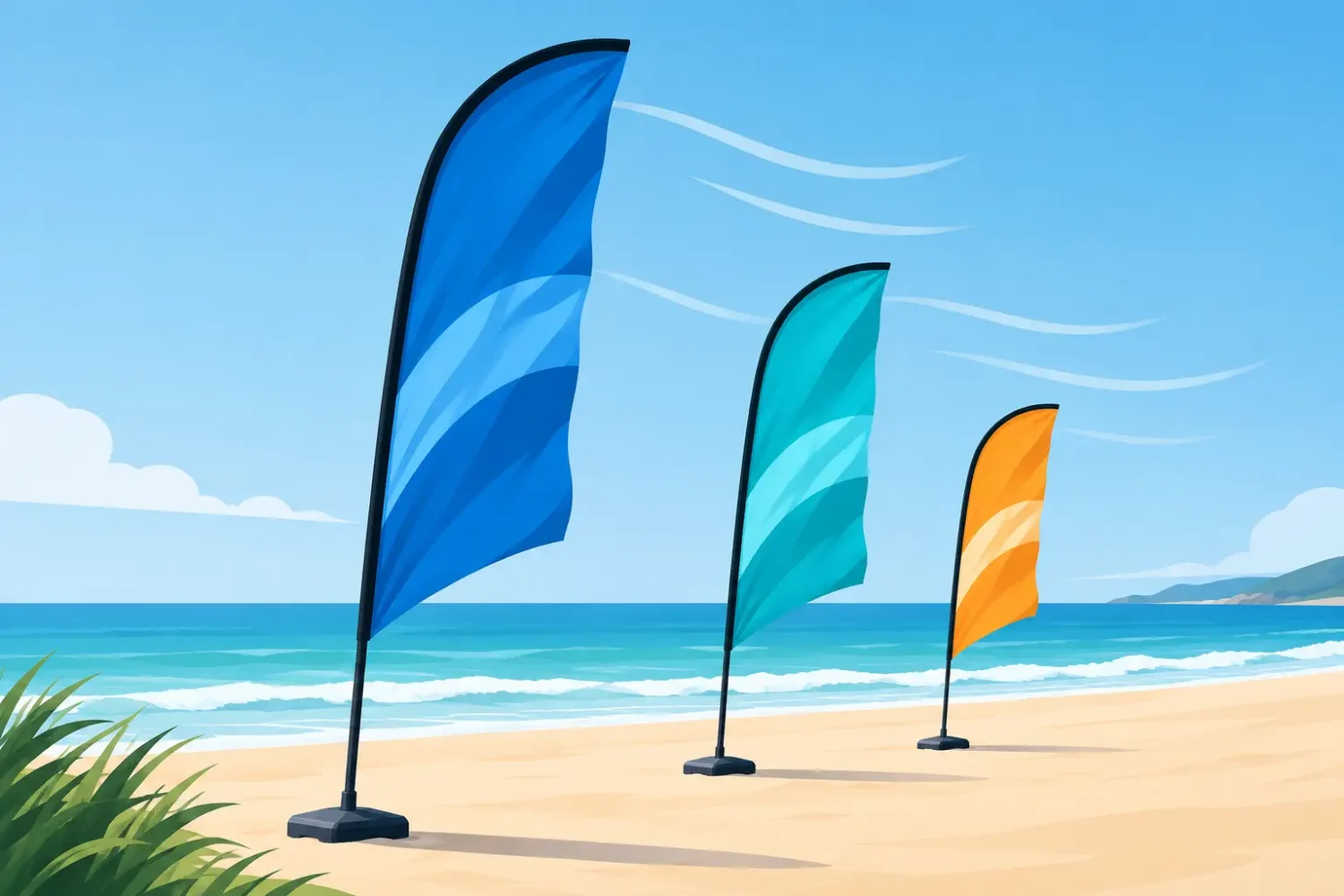
A beach flag that folds over, spins around its pole, or lifts from its base does not help a promotion. So, are beach flags wind resistant? Yes, when the flag shape, flexible pole, correctly matched base, and installation method are selected for the actual site conditions. They are designed for outdoor movement, but they are not fixed sign structures built to remain deployed through every weather condition.
For event organizers, retailers, and promotional teams, the practical question is not whether a beach flag can handle any wind. It is whether the selected hardware can remain visible, stable, and presentable during the expected conditions of a campaign. A small sidewalk activation, an open field roadshow, and a beachside product launch place very different demands on the same display format.
Are beach flags wind resistant in normal outdoor use?
Beach flags are made to work in light to moderate wind. Their slim, flexible fiberglass or composite poles bend with gusts rather than trying to resist all force in one rigid position. The printed flag also allows air to flow around its curved edge as the pole flexes. This is why a properly assembled feather flag, teardrop flag, or blade flag performs differently from a flat banner tied between two fixed points.
Wind resistance does not mean windproof. Strong, sudden gusts can bend the pole excessively, pull a lightweight base across smooth pavement, or place too much stress on the fabric and pole joints. Heavy rain can add weight to the print and soften ground around a stake. For this reason, beach flags should be brought down when conditions become unsafe or when an event area is unattended.
The display should be treated as portable promotional hardware. It is suitable for daily outdoor visibility, temporary events, forecourt promotions, sports days, retail openings, and exhibition entrances. It is not a substitute for engineered permanent signage.
What determines beach flag wind resistance?
The hardware and setup matter as much as the printed graphic. A high-quality fabric print cannot compensate for an undersized base, and the heaviest base may still perform poorly if the pole is not fully seated.
Flag shape and print area
Feather flags have a longer, more open profile. They offer a large vertical print area and strong movement in a breeze, making them useful where visibility from a distance is the priority. That larger surface also catches more wind than a compact shape.
Teardrop flags have a rounded, tensioned outline. Because the fabric is held in a fixed shape, the message remains readable even when there is little wind. Their lower, more contained profile can be a practical choice for locations with regular breezes, although size still affects the load on the base.
Blade flags sit between these two options. They provide a clear rectangular-style layout while retaining a curved top edge and flexible pole system. The best format depends on required graphic area, viewing distance, available space, and local wind exposure.
A larger flag is not automatically the better choice. A tall flag can be seen over crowds, parked vehicles, and trade show structures, but it also creates greater leverage at the base. If the location is exposed, choosing a smaller flag with an appropriate base is often more effective than using the largest available size with minimal ballast.
Pole construction and assembly
Most beach flag poles use segmented fiberglass, carbon composite, or flexible mixed-material sections. This controlled flexibility is a working feature, not a defect. The pole should bend under ordinary wind and return to shape without kinking.
Correct assembly is essential. Each section must be inserted fully, and the flag sleeve must be pulled smoothly over the complete pole length. If sections are loose or the flag is twisted, the stress is concentrated in the wrong area. This can reduce stability and shorten the usable life of the hardware.
Inspect poles regularly for cracks, splinters, worn connectors, or permanent bends. A damaged pole should be replaced rather than used for another outdoor event. It may fail without warning in a gust.
Base type and ballast
The base is usually the deciding factor in whether a beach flag remains stable. Select it according to the surface first, then add weight based on flag size and wind exposure.
A ground spike is suitable for grass, soil, and compacted earth when it can be driven securely into the ground. It is generally a stable option for outdoor fields and roadside activations, but it should not be used in loose sand without additional support.
A cross base is practical for indoor venues, sheltered pavement, and short-term placements where a low-profile footprint is needed. Outside, it normally requires a water bag or weighted ring. Filling the ballast fully and placing it evenly around the base makes a major difference.
A square metal base provides more built-in weight and is often suitable for paved retail fronts, showroom entrances, and moderately exposed outdoor areas. For high-traffic locations, it also gives a more substantial appearance and reduces the chance of the display being moved accidentally.
Water-filled or sand-filled base systems can add considerable stability where transport space is limited. They should be filled on site and checked for leaks before use. Water is convenient, but sand usually adds more weight for the same volume. The trade-off is slower setup and cleanup.
Match the base to the site, not just the flag
A common purchasing mistake is specifying flag hardware by height and ignoring the placement surface. The same 10-foot flag may perform well with a weighted cross base beside a sheltered storefront but require a ground spike or heavier base in an open parking lot.
Before ordering, assess whether the location is grass, concrete, tile, asphalt, sand, or indoor flooring. Consider nearby buildings, which can block steady wind but create abrupt gusts around corners and entryways. Open sports grounds, waterfront areas, elevated platforms, and wide roadsides need more conservative base selection than enclosed courtyards.
Foot traffic matters as well. A stable base reduces movement, but it must also be positioned where customers, staff, and delivery teams will not trip over it. Keep the display outside door swing areas, vehicle paths, emergency exits, and narrow walkways. A beach flag needs room to flex without striking a wall, awning, or another display.
Setup practices that improve outdoor performance
Start by placing the base on level ground. An uneven base can lean before wind becomes a factor. Insert the rotating spindle or pole connector fully, then confirm that the pole turns freely if the design includes a rotating mechanism. Rotation helps the flag align with the wind instead of holding the full force at an unfavorable angle.
Pull the flag fabric tight enough to remove loose folds, but do not force the pole into an excessive bend during assembly. Secure the bottom bungee or tension strap according to the hardware design. The graphic should look clean before the wind begins to move it.
If using a cross base outdoors, fit the compatible water bag or weight before opening the flag. Do not rely on loose items, boxes, or improvised weights that can shift, damage the hardware, or create a safety issue. For a multi-flag setup, leave enough spacing so flags do not collide as they rotate.
During an event, check the hardware after weather changes. Tighten connections, reposition ballast if necessary, and remove the flag if gusts become too strong. Taking down a display early is less costly than replacing a torn print, cracked pole, or damaged base.
Fabric and print choices also matter
Most beach flag graphics are produced on polyester fabric because it is lightweight, flexible, and suitable for dye-sublimation printing. The method drives ink into the fabric fibers, supporting strong color and allowing the flag to remain flexible under movement. Single-sided prints typically show a reversed image on the back, while double-sided options use two printed layers with a blocker material between them for readable graphics on both sides.
For wind performance, avoid adding unnecessary attachments, rigid panels, or heavy decorative elements to the flag. Keep the design within the intended print area and use finished edges and reinforced sleeves appropriate to the pole system. Clean, high-contrast graphics are usually more useful than dense text, especially when the flag is moving.
When should beach flags be removed?
Remove beach flags during severe weather warnings, strong sustained winds, thunderstorms, or periods when nobody is available to monitor the installation. They should also be taken down overnight unless the hardware, base, placement, and site policy specifically support extended deployment.
After rain, check the print fabric, pole joints, and base area. Dry the flag before packing it away to prevent odor, staining, or mildew. Store poles in their carry bag and avoid placing heavy objects on them, as bent segments can affect the next installation.
A beach flag is an efficient outdoor display when its size, base, and placement are specified as one system. For a campaign that must stay visible beyond the first gust, select the hardware for the site conditions and give the setup the same attention as the printed graphic.
Related Posts