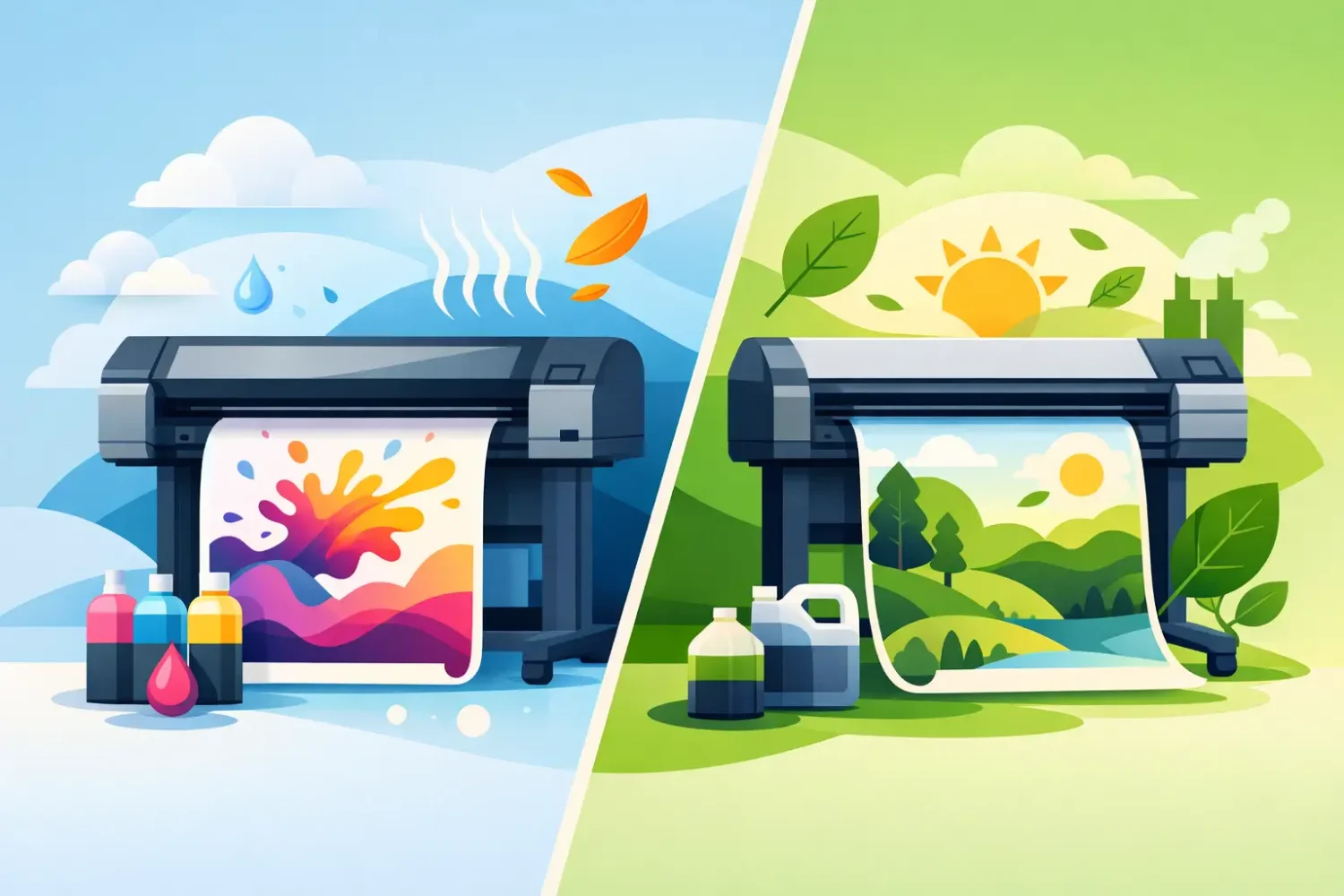
A roll-up banner that looks sharp under exhibition lighting, a storefront graphic that installs without a strong solvent smell, and an outdoor PVC banner that holds up through rain do not always require the same print method. Latex versus eco solvent is a practical production decision: it affects the media options, drying time, finish, durability, and the way a printed graphic performs after installation.
For marketing teams, event organizers, and print buyers, the right choice starts with the actual display format. A short-run indoor wall graphic has different requirements from a long-term outdoor barricade banner or a fleet of window decals. Ink type matters, but the substrate, laminate, mounting method, and campaign timeline matter just as much.
Latex Versus Eco Solvent: The Core Difference
Latex printing uses water-based pigment inks with polymer resins. During printing, heat evaporates the water and cures the resin so the pigment forms a durable layer on the media. The finished print is generally dry when it leaves the printer and can move into trimming, laminating, or mounting with less waiting.
Eco solvent printing uses solvent-based inks formulated with lower odor and lower volatile organic compound levels than traditional full-solvent inks. The solvent helps the ink penetrate or bond to coated vinyl and other compatible media. It remains a standard choice for adhesive vinyl, PVC banner, sticker materials, and outdoor signage.
Neither method is automatically better. Latex is often selected for faster finishing and indoor-sensitive applications. Eco solvent remains highly effective where buyers need familiar vinyl performance, strong color on common sign media, and an economical solution for outdoor graphics.
Where Latex Printing Fits Best
Latex is well suited to retail graphics, exhibition panels, indoor promotional displays, wall coverings, backlit applications, and projects that need to be handled soon after printing. Since the output is typically ready for finishing immediately, it can reduce the waiting period between printing and installation.
This matters when producing branded graphics for roll-up stands, popup displays, LED light frames, counters, and point-of-sale materials. A campaign may need several display formats prepared at once: a PVC roll-up banner, a mounted board, window graphics, and a light frame insert. Faster dry-to-finish handling helps keep those jobs moving through production.
Odor is another consideration. For displays used in malls, offices, showrooms, schools, healthcare settings, or enclosed event areas, latex is often preferred because it has a lower perceived odor than solvent-based printing. That does not remove the need to select suitable media and allow proper handling, but it can be useful for indoor environments where the graphics will be installed close to staff or visitors.
Latex can print well on a broad range of coated and uncoated materials, including banner, paper, textiles, films, and certain vinyl products. However, not every media performs identically. Heat-sensitive films may require careful printer settings, and some specialty self-adhesive materials are better tested before committing to a large run.
Where Eco Solvent Printing Fits Best
Eco solvent is a dependable option for standard sign and display work. It is commonly used for outdoor banners, self-adhesive vinyl, one-way vision film, vehicle graphics, window stickers, floor graphics with the correct laminate, and promotional decals. It offers strong color density and a familiar finish on widely used PVC-based materials.
For an outdoor promotion, the ink’s weather resistance is only part of the specification. The banner weight, hem and eyelet placement, tension, wind exposure, and installation method all influence service life. Eco solvent printing on suitable PVC banner media is a practical combination for storefront banners, roadside promotions, fencing graphics, and event barricade displays.
Eco solvent output needs adequate time to outgas before lamination. If a vinyl print is laminated too early, residual solvent can contribute to bubbling, lifting, or adhesive problems later. The exact waiting time depends on ink coverage, media, temperature, humidity, and printer profile. For production planning, this is a real difference between latex and eco solvent, especially when a job includes contour cutting, lamination, or mounting.
Eco solvent can be a cost-effective route for buyers ordering standard vinyl graphics in volume. If the application is a conventional outdoor sticker, PVC banner, or temporary campaign graphic, it may deliver the appearance and durability required without moving to a different print process.
Color, Finish, and Viewing Distance
Both latex and eco solvent can produce professional full-color graphics. The more useful question is not which technology has the best color in general, but what the graphic needs to do at its final viewing distance.
A beach flag viewed from across a parking area needs strong contrast, readable type, and a clear logo. A retail counter wrap viewed at arm’s length needs sharper small text, controlled gradients, and a finish that suits the lighting. An LED light frame requires media designed for backlighting so colors remain balanced when illuminated. Ink selection supports these results, but artwork setup and media selection are equally important.
Glossy vinyl can make colors look more intense but may reflect overhead lighting. Matte media reduces glare and is often easier to read in showrooms, exhibition halls, and office areas. Lamination can add protection, change the surface appearance, and improve cleanability, but it should be specified based on use rather than added by default.
For fine text, logos, and product images, provide production-ready artwork at the correct scale. A high-resolution file does not correct a poor layout, low-contrast type, or image that has been enlarged beyond its usable quality. This applies to latex and eco solvent alike.
Durability Depends on the Full Build
Print durability is often described as an ink issue, but the finished product is a system. Consider the ink, media, laminate, adhesive, mounting surface, location, and expected lifespan together.
An unlaminated indoor poster may be perfectly suitable for a two-week promotion. A storefront vinyl graphic exposed to cleaning, sun, rain, and frequent contact may need a more durable film and protective laminate. A removable wall graphic needs an adhesive designed for clean removal, while a permanent outdoor decal requires different adhesive strength and surface preparation.
In hot, humid, high-rainfall conditions, such as those common across Malaysia, edge sealing, proper curing or outgassing, and correct installation become more important. A quality print can still fail early if it is applied to a dusty, damp, textured, or poorly prepared surface.
Match the Method to the Display Format
For roll-up stands and popup displays, the main priorities are flatness, color consistency, scratch resistance, and the appropriate display film. Latex is often useful when the job needs quick finishing, while eco solvent remains suitable on compatible roll-up media when production time allows.
For PVC banners, both methods can work well. Eco solvent is a common choice for outdoor banners and large promotional runs. Latex can be selected where turnaround, indoor use, or lower odor handling is a priority. The correct banner thickness and finishing matter more than choosing an ink type by name alone.
For window graphics, consider whether the output will be applied inside or outside the glass, whether light must pass through, and whether removal is required. Clear film, frosted film, white vinyl, and one-way vision media each behave differently. Eco solvent is widely used for these films, while latex can also be a strong option when the selected media is approved for the process.
For stickers and labels, determine whether the application needs gloss, matte, transparent, synthetic, hologram, or metallic-looking material. Specialty sticker stocks should be matched to the printer and intended use. A transparent sticker on a dark surface, for example, may need white ink or a white backing strategy to keep the artwork visible. Neither latex nor eco solvent automatically solves that specification issue.
Questions to Settle Before Production
Before approving a print method, define the campaign duration, indoor or outdoor placement, final display hardware, media type, finish, and installation date. Also confirm whether the graphic will be laminated, contour cut, mounted, folded, rolled, or backlit.
If speed after printing is critical, latex may be the better production fit. If the job is a standard outdoor vinyl or banner application and the schedule allows proper outgassing before finishing, eco solvent may be the efficient choice. If the display needs long outdoor exposure, specify the complete material build rather than relying on ink labels alone.
The best print is the one that fits the hardware, survives the environment, and arrives ready to install. Start with where the graphic will be used, then select the media and print method that support that job.
Related Posts