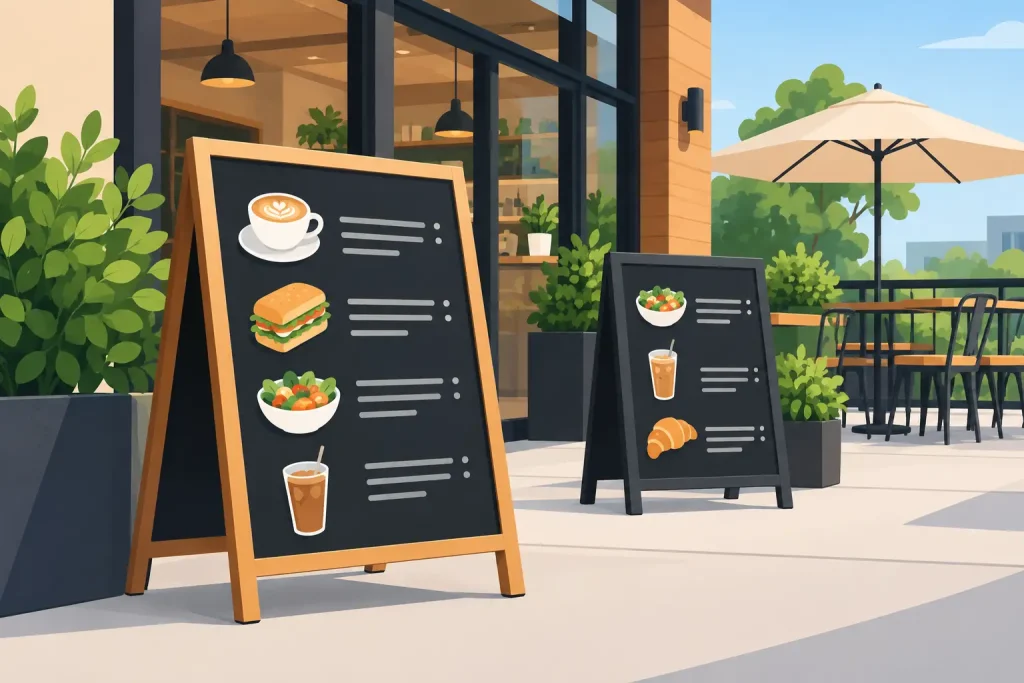
A sign that looks good on a screen can fail quickly outside. Wind shifts the hardware, sun reduces contrast, rain reaches unprotected edges, and foot traffic only gives the message a few seconds. This outdoor promotional signage guide focuses on choosing display formats, graphic materials, and print production based on where the sign will be used and what it needs to do.
For business promotions, the first decision is not the artwork. It is the operating environment. A roadside promotion, mall entrance activation, outdoor market booth, storefront campaign, and exhibition queue all require different hardware. Match the display system to the site first, then produce graphics that fit the frame, stand, or mounting method.
Start With the Sign’s Job and Location
Outdoor signage should have one primary job: direct people, promote an offer, identify a location, or create a branded backdrop. Trying to do all four on one small panel usually produces weak results. A temporary sale sign needs a large offer and clear call to action. A directional sign needs an arrow, destination, and enough contrast to be read at a distance. A branded event backdrop needs repeatable logos and a clean layout that works in photographs.
Next, review viewing distance and dwell time. Pedestrians walking past a retail entrance can read a short headline and price message. Drivers need larger type, fewer words, and a simple visual hierarchy. People waiting in a registration line have more time and can engage with product details, QR codes, or a campaign message.
Site conditions affect the purchase as much as the message. Check whether the display will be placed on pavement, grass, tile, or uneven ground; whether it is exposed to wind; whether it will be moved daily; and whether it needs to operate after dark. These details determine the required base, weight, frame, and finishing method.
Outdoor Promotional Signage Guide: Choose the Right Format
There is no single best outdoor display. The correct format depends on campaign duration, available space, visibility requirements, and how often the unit will be transported.
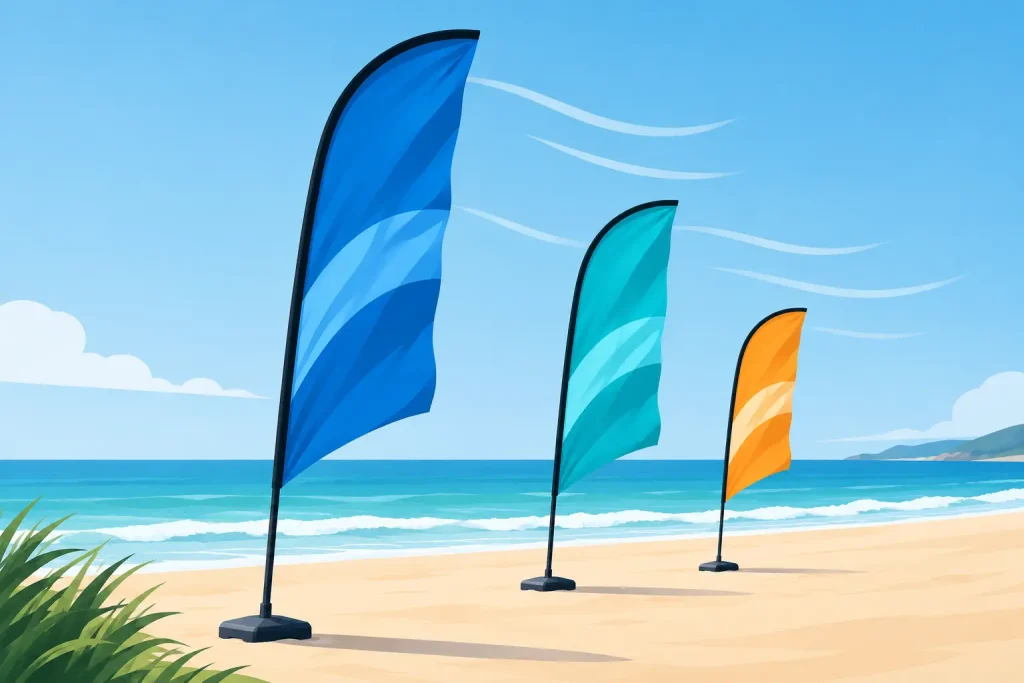
Beach flags for movement and distance
Beach flags are useful for forecourts, roadshows, sports events, cafes, property launches, and temporary retail promotions. Their height and movement help attract attention where many fixed signs compete for notice. They work best with short messages, bold logos, directional arrows, and high-contrast colors.
Choose the base according to the surface. A cross base may suit hard, stable ground when additional weight is used. A water base adds stability for exposed locations. Ground spikes are suitable for grass or soil, but not for paved locations. Flag graphics should not carry dense product information because the fabric moves and is often viewed from an angle.
Roll-up stands for sheltered exterior areas
Roll-up stands are practical for covered walkways, building lobbies, tented activations, retail entrances, and event registration areas. They pack into a carry bag and can be replaced with updated graphics between campaigns. However, a standard roll-up stand is not designed for strong wind or open, unsheltered conditions.
Use this format where portability matters more than weather resistance. Keep it inside a protected perimeter and avoid placing it where doors, air movement, or crowd contact can knock it over. PVC roll-up graphics provide a familiar, economical option for short-term promotional use.
Rigid boards, frames, and barricade displays
Rigid signage is suitable when the message needs a flat surface and stable presentation. KT board stands can support lightweight promotional panels for controlled temporary setups. Aluminum frames and wooden frames offer a more structured look for storefront, venue, or display applications. Barricade displays make productive use of crowd-control barriers at launches, races, queue lines, and outdoor events.
For longer viewing distances, rigid panels allow larger type and cleaner imagery than many portable fabric formats. They also suit menus, schedules, tenant information, sponsor panels, and wayfinding. The trade-off is transport and storage. Large rigid boards require careful handling, and replacement can cost more than changing a roll-up or flag graphic.
LED light frames for evening visibility
If the promotion must remain visible in low-light conditions, an LED light frame can provide consistent illumination. This is useful for retail frontage, indoor-outdoor transition areas, evening events, and branded product displays. Lighting improves graphic visibility, but it also introduces power, positioning, and maintenance requirements.
Do not assume illumination fixes a weak design. The graphic still needs strong contrast, suitable image resolution, and a message that can be understood quickly. Avoid overly dark artwork when the frame will be viewed in mixed daylight and nighttime conditions.
Match Graphic Materials to Exposure and Campaign Length
Outdoor graphics must handle more than visual presentation. They need to suit the display hardware, printing method, installation surface, and expected lifespan.
For temporary campaigns, PVC and PP white materials can provide a clean printed finish for posters, roll-up graphics, and promotional panels. Synthetic materials are useful where resistance to tearing or moisture is needed. For adhesive applications, the surface matters: smooth glass, painted walls, metal, plastic, and textured surfaces each require the correct sticker construction and adhesive performance.
Transparent stickers work when the glass itself is part of the design, such as storefront windows or vehicle-style graphic applications. Matt silver and hologram stickers create specialty effects for labels, product promotions, and campaign assets, but they should be selected for a clear reason. Reflective or metallic surfaces can change the apparent color of printed artwork and may reduce readability under certain lighting.
Finishing also affects durability. Lamination, trimming, mounting, hemming, eyelets, and edge reinforcement are not optional production details when the sign will be handled, mounted, or exposed. A banner that is pulled tight through eyelets requires adequate reinforcement. A mounted board needs clean edges that will not peel or chip during installation.
Select Print Production for the Application
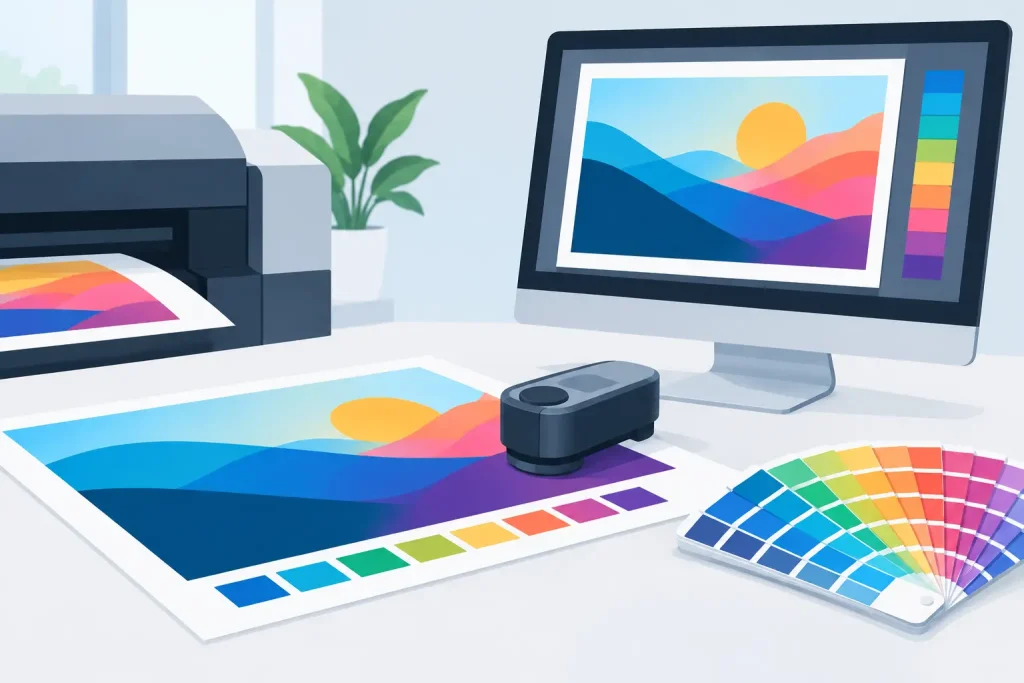
Print technology should be chosen based on substrate, color requirements, finish, turnaround, and intended use. Solvent and eco-solvent printing are commonly specified for durable graphics and adhesive media. UV printing suits many rigid materials and can deliver direct printed output on suitable boards. Latex printing is a practical option for various graphic applications where color quality and production flexibility matter. Dye sublimation is commonly used for fabric graphics, including selected flag and display applications.
The key is to specify the final product, not just the print method. State the display format, finished size, installation location, surface or base requirement, campaign duration, and whether the graphic will be replaced later. This allows the supplier to recommend a workable combination of hardware, media, printing, and finishing.
Resolution should be considered at viewing distance. A large backdrop viewed from several feet away does not need the same image detail as a small countertop sign viewed close up. Supply logos as vector artwork when possible. For photographs, use high-resolution source files and avoid enlarging small web images. Blurry images, weak blacks, and low-contrast type become more obvious on large-format output.
Build Artwork for Fast Reading
Outdoor signage is not a brochure. The layout should lead the eye from the main message to the action. Start with the offer, brand, or direction. Then add supporting information only if the audience has enough time to read it.
Use a limited number of type sizes and keep important information away from edges, eyelets, frame borders, and roll-up cassette areas. A logo placed too close to a flag edge may distort when the fabric moves. A QR code placed near the bottom of a roll-up may be blocked by bags, furniture, or people standing nearby.
Color contrast matters more outdoors because sunlight and reflections reduce subtle differences. Dark type on a light background, or light type on a dark background, is generally easier to read than low-contrast color combinations. Test the design at reduced size before production. If the headline is not clear on a phone screen from arm’s length, it is unlikely to perform well from across a walkway.
Plan Installation, Safety, and Replacement
A good display system should be easy to set up correctly by the staff who will use it. Confirm the installation method before printing. Measure the available area, note obstacles such as doors and drains, and allow space for customers to move around the display without creating a hazard.
For wind-exposed locations, use hardware designed for the conditions and add approved ballast where needed. Never rely on loose objects that can shift or create a trip risk. Inspect flags, banners, bases, frames, and fittings at the start of each event day. Replace graphics when fading, curling edges, torn eyelets, or outdated promotions affect the presentation.
Ordering hardware and printed graphics from one source simplifies size matching and reduces the risk of producing a panel that does not fit the stand. My Inkjet can support this approach with display hardware, large-format print options, specialty materials, and finishing in one order workflow.
Before approving production, ask one final practical question: will the sign still look clear, stable, and on-brand after several hours in its actual location? If the answer is uncertain, adjust the hardware, material, or artwork before it reaches the site. That small check often prevents the most expensive kind of signage problem: a campaign that is installed but not seen.
Related Posts